
Learn more about Dumbbell Meadows Row
Exercise Facts
- Movement Pattern Anti-Rotation, Hinge, Pull
- Muscle Group Biceps, Core, Lats, Obliques, Rear Delts, Upper Back
- Equipment Bench, Dumbbell
- Environment Gym, Home
- Skill Level Advanced, Intermediate
Detailed How-To Dumbbell Meadows Row
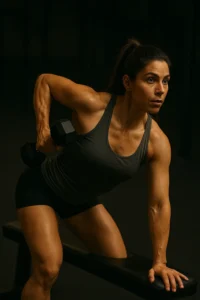
The dumbbell Meadows row is one of the most effective unilateral rowing variations for building a strong and well-balanced upper back. Originally popularised by bodybuilder John Meadows, this exercise uses a staggered stance and a long-range pulling path to create significant tension through the lats, upper back and obliques. The dumbbell Meadows row forces you to brace your core, resist rotation and row with strict mechanics, making it ideal for athletes who want to build functional strength and improve posture.
In hybrid and functional fitness training, unilateral strength is essential. Movements such as sandbag shouldering, kettlebell snatches, barbell cleans and even SkiErg pulls rely on strong lat engagement and trunk stability. The dumbbell Meadows row reinforces these qualities by challenging the lifter to maintain alignment through the hips, ribs and shoulders throughout each rep. This makes it a valuable complement to exercises like the Renegade Row, Dumbbell Seal Row and Single-Arm Dumbbell Dead Stop Row within the RB100.Fitness library.
The elevated dumbbell starting position increases the length of the pull and improves lat recruitment. Because the dumbbell travels in an arced path, athletes learn to engage the lower lat fibres without hitching the shoulder or twisting through the torso. This makes the dumbbell Meadows row particularly effective at developing symmetrical lat growth and improved pulling endurance. For HYROX athletes, this can translate into better control during wall ball pickups, stronger sled pull mechanics and improved resistance against spinal rotation.
For external technique insights, resources such as MuscleWiki, ACE Fitness and Muscle & Strength provide useful references on rowing fundamentals, scapular control and trunk stability:
Primary & Secondary Muscles Worked
The primary muscles used in the dumbbell Meadows row are the lats and upper back, which initiate and control the rowing action. The rear delts provide additional pulling power and shoulder positioning. Secondary muscles include the obliques and core, which resist rotation, and the biceps and erectors, which stabilise and assist throughout the movement.
The combination of unilateral loading, hip hinge positioning and long pulling range makes the dumbbell Meadows row one of the best movements for developing structural strength across the entire posterior chain. It is suitable for strength-focused sessions, hypertrophy blocks and hybrid conditioning programmes where stability and control are paramount.