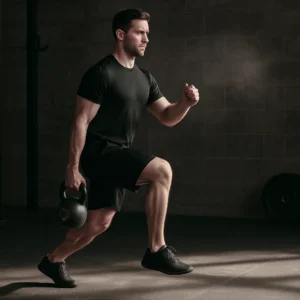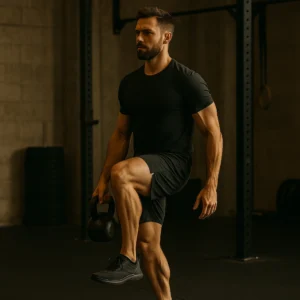

Learn more about Kettlebell Suitcase Deadlift
Exercise Facts
- Movement Pattern Anti-Rotation, Deadlift Pattern, Hinge
- Muscle Group Core, Forearms, Glutes, Hamstrings, Obliques
- Equipment Kettlebell
- Environment Gym, Home
- Skill Level Beginner, Intermediate
Detailed How-To Kettlebell Suitcase Deadlift
The kettlebell suitcase deadlift is a highly functional hinge variation that builds lower-body strength while challenging the body to resist rotation. By placing the kettlebell on only one side of the body, this exercise forces the core and obliques to stabilise the spine while the glutes and hamstrings drive the lift. Unlike a traditional deadlift, the kettlebell suitcase deadlift tests your ability to maintain symmetry under asymmetrical loading, making it exceptionally valuable for hybrid athletes, runners, rotational athletes and anyone training for HYROX-style conditioning.
This movement is especially useful for correcting imbalances. Because the kettlebell is held to one side, the athlete must brace harder through the obliques and maintain neutral alignment through the hips and ribs. This creates a powerful anti-rotation stimulus that carries over to movements such as the Renegade Row, Single-Arm Dead Stop Row and Sandbag Shouldering. It also strengthens grip, improves hip engagement and reinforces proper deadlift mechanics in a low-risk, accessible format.
The kettlebell suitcase deadlift teaches the athlete to move with control during hinge patterns without allowing the weight to pull the torso into lateral flexion. This improves stability during loaded carries, single-leg variations and posterior chain movements like the Barbell Romanian Deadlift (RDL). Within the rb100.fitness exercise ecosystem, the kettlebell suitcase deadlift fits naturally into the Functional Stability Series, the Core Control Series and the Unilateral Power Series due to its unique stability demands.
For additional technique resources and comparison, external references such as MuscleWiki, ACE Fitness and Fitness Blender offer detailed insights into hinge patterns and unilateral loading mechanics:
https://musclewiki.com/
https://www.acefitness.org/
https://www.fitnessblender.com/
Primary & Secondary Muscles Worked
The kettlebell suitcase deadlift primarily targets the glutes and hamstrings, the main drivers of the hip hinge. Secondary muscles include the core and obliques, which stabilise the torso against rotation, and the forearms and upper back, which control the kettlebell and maintain posture. The erectors support the spine throughout the lift, helping prevent flexion or deviation under load.
This combination of strength, stability and anti-rotation control makes the kettlebell suitcase deadlift an essential accessory movement for athletes wanting better symmetry, stronger lower-body performance and improved lifting mechanics. It is suitable for strength blocks, conditioning circuits and movement-quality sessions.