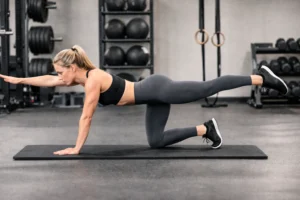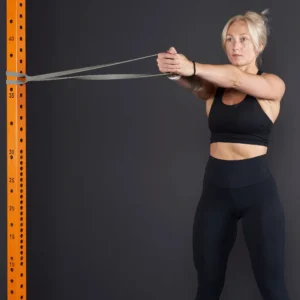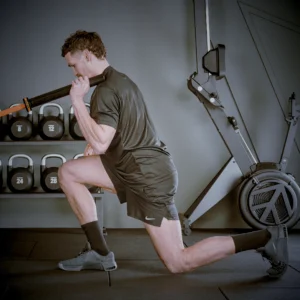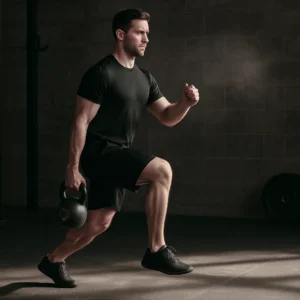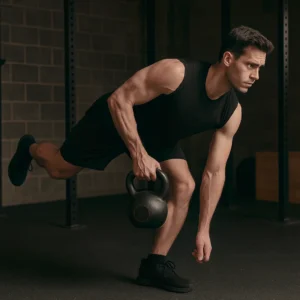

Learn more about Single-Leg RDL (Anti-Rotation)
Exercise Facts
- Movement Pattern Anti-Rotation, Hinge, Isometric Core Control, Unilateral
- Muscle Group Core, Glutes, Hamstrings, Lower Back
- Equipment Cable Machine, Dumbbell, Kettlebell, Resistance Band
- Environment Gym, Home
- Skill Level Advanced, Intermediate
Detailed How-To Single-Leg RDL (Anti-Rotation)
The single-leg RDL (anti-rotation) is an advanced unilateral hinge exercise that combines posterior-chain loading with significant core stabilisation demands. By performing a single-leg Romanian deadlift while resisting a rotational force, the athlete must control hip movement, trunk alignment, and balance simultaneously.
Unlike a standard single-leg RDL, the anti-rotation element introduces a lateral or diagonal pull, commonly applied via a cable, resistance band, or offset dumbbell load. This external force attempts to rotate the torso, forcing the obliques and deep core musculature to stabilise the spine while the glutes and hamstrings drive the hinge pattern.
Primary muscles worked include the gluteus maximus and hamstrings of the working leg, which control hip flexion and extension. Secondary stabilisers such as the obliques, erector spinae, and adductors play a critical role in preventing trunk rotation and pelvic shift. The calves and upper back contribute to balance, posture, and load control throughout the movement.
This exercise has strong carryover to athletic performance, particularly in running, cutting, and loaded carries where unilateral force production and rotational control are required. It is also highly valuable in strength programmes focused on injury resilience, as it exposes asymmetries in balance, hip stability, and core engagement. When performed with control and intent, the single-leg RDL (anti-rotation) reinforces efficient force transfer through the kinetic chain.