
Learn more about Box Squat (Various Heights)
Exercise Facts
- Movement Pattern Controlled Squat, Posterior Chain, Squat, Strength
- Muscle Group Core, Glutes, Hamstrings, Quadriceps
- Equipment Barbell, Bench, Plyo Box, Squat Rack
- Environment Gym, Home
- Skill Level Advanced, Beginner, Intermediate
Detailed How-To Box Squat (Various Heights)
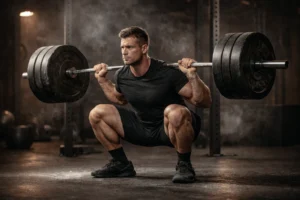
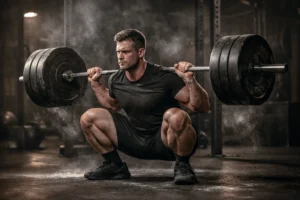
The box squat is a squat variation that uses a box, bench, or platform to standardise squat depth and reinforce controlled movement. By squatting to a fixed target, athletes develop consistent depth, improved positioning, and greater awareness of hip and knee mechanics.
Box squats can be performed using various box heights, each targeting different strength qualities. Higher boxes reduce range of motion and allow greater loading, which is useful for developing confidence, reinforcing hinge mechanics, and building posterior chain strength. Lower boxes increase range of motion and challenge mobility, control, and strength at deeper joint angles.
Unlike touch-and-go squats, the box squat encourages the athlete to sit back under control, lightly contact the box, and then drive upward with intent. This pause removes elastic rebound and increases demand on the glutes, hamstrings, and trunk stabilisers. When performed correctly, the box squat builds strength from the bottom while reducing unnecessary knee stress.
Primary muscles worked include the glutes and quadriceps, which drive hip and knee extension during the ascent. Secondary muscles such as the hamstrings and adductors assist with hip stability and depth control, while the erector spinae and core maintain spinal integrity under load.
Box squats are widely used in strength training, rehabilitation settings, and functional fitness programming. They are particularly effective for teaching squat mechanics, improving depth consistency, and addressing sticking points. By adjusting box height, coaches can scale the movement for beginners or target specific weaknesses in advanced lifters.