
Learn more about Kettlebell Suitcase Deadlift to March
Exercise Facts
- Movement Pattern Anti Lateral Flexion, Carry, Core, Gait, Hinge, Locomotion
- Muscle Group Abs, Calves, Erectors, Forearms, Glutes, Hamstrings, Hip Flexors, Obliques, Traps
- Equipment Kettlebell
- Environment Gym, Home
- Skill Level Intermediate
- HYROX Station Farmer’s Carry, Run
Detailed How-To Kettlebell Suitcase Deadlift to March
The kettlebell suitcase deadlift to march combines two powerful patterns into one smooth sequence. First you perform a kettlebell suitcase deadlift to load the hinge and posterior chain. Then, instead of simply setting the weight down or walking away, you transition straight into a controlled suitcase march that challenges your core and balance. This makes the kettlebell suitcase deadlift to march an ideal link between pure strength work and functional loaded gait.
At Relentless Bravery Fitness we treat this as a progression from the standard kettlebell suitcase deadlift and a stepping stone towards the full kettlebell suitcase march that already lives inside the rb100.fitness Exercise Library. It sits neatly alongside classic deadlift variations like the barbell Romanian deadlift and sandbag squat clean, giving hybrid athletes a way to connect strong hinges with stable, real world carries.
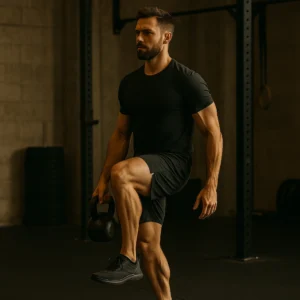
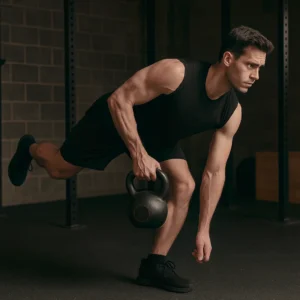
To perform the kettlebell suitcase deadlift to march, you pick the kettlebell up from the floor in a clean hip hinge like your usual suitcase deadlift. Once you are tall and stable, you immediately move into a slow, deliberate march while keeping the kettlebell hanging by your side. The asymmetrical load tries to pull you off to one side as the legs move underneath you. Your job is to resist that pull with the obliques, abs and erectors while the hamstrings and glutes control the hinge and support each step.
This combination is particularly useful for anyone preparing for HYROX style events or hybrid conditioning blocks, where strong posterior chain work must blend with efficient running and carrying. You can pair it with traditional deadlifts on heavy days, then use lighter kettlebells on conditioning days to reinforce posture under fatigue. The kettlebell suitcase deadlift to march also works well as a teaching tool before you push athletes into heavier farmer’s carries, sandbag carries or barbell front rack carries.
If you want more background on hip hinge mechanics and loaded carries, resources like ACE Fitness and MuscleWiki provide helpful guides on deadlifts and walks with external load. You can then cross reference those with related exercises on rb100.fitness such as the kettlebell single leg Romanian deadlift and sandbag bear hug carry to build a clear progression pathway.
Over time you can progress the kettlebell suitcase deadlift to march by increasing distance, time under tension, or kettlebell weight. However, posture always comes first. When you keep the ribcage stacked over the pelvis and avoid leaning towards the kettlebell, even a moderate load will create a serious training effect for the trunk and hips. That is the Relentless Bravery Fitness approach: earn the right to progress by moving well first, then layering intensity on top.
Primary muscles:
- Hamstrings: Drive the hip hinge and help control the lowering and lifting phases of the suitcase deadlift.
- Glutes: Extend the hips to stand tall and stabilise the pelvis as you transition into the march.
- Erector spinae: Maintain a strong, neutral spine through both the hinge and the marching steps.
- Obliques: Work hard to resist lateral flexion as the kettlebell loads one side of the body.
Secondary and stabiliser muscles:
- Abs: Help keep the ribcage stacked over the pelvis and support overall trunk stiffness.
- Forearms and grip: Maintain a secure hold on the kettlebell during the deadlift and march.
- Traps and upper back: Keep the shoulder packed and stop the kettlebell from dragging you forwards.
- Calves and hip flexors: Assist with smooth, controlled steps and single leg balance during the march.
Together these muscles make the kettlebell suitcase deadlift to march a highly efficient exercise for building posterior chain strength, core stability and functional loaded gait.