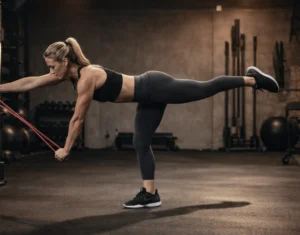

Learn more about Dumbbell Bent-Over Reverse Fly
Exercise Facts
- Movement Pattern Horizontal, Isolation, Pull
- Muscle Group Rear Delts, Rhomboids, Traps, Upper Back
- Equipment Dumbbell
- Environment Gym, Home
- Skill Level Advanced, Beginner, Intermediate
Detailed How-To Dumbbell Bent-Over Reverse Fly
The Dumbbell Bent-Over Reverse Fly exercise targets the rear delts, traps, and rhomboids — muscles responsible for posture and shoulder stability. It’s a precise movement that balances pressing strength by developing the pulling muscles of the upper back.
To perform, hold a dumbbell in each hand with a neutral grip and stand with your feet hip-width apart. Hinge at the hips until your torso is nearly parallel to the floor, keeping a flat back and braced core. Let the dumbbells hang below your shoulders with a soft bend in your elbows. From here, raise the dumbbells out to the sides in a wide arc until they reach shoulder height, then slowly lower them to the start position.
This exercise strengthens the posterior deltoids, traps, and rhomboids, helping correct rounded shoulders and prevent imbalances from heavy pressing or desk posture. It’s also a great movement for improving scapular control, which supports overhead lifting stability.
Common mistakes include using momentum to swing the weights, rounding the lower back, or overextending the arms. Cue “move with control,” “lead with elbows,” and “keep chest tall.”
At Relentless Bravery Fitness, this movement symbolizes equilibrium — strength through symmetry and control through intention.
Program 3–4 sets of 12–15 reps, resting 45–60 seconds between sets. Use light to moderate dumbbells to maintain strict form and tension through every repetition.
For detailed form guidance, check the MuscleWiki Reverse Fly Guide, and see the ACE Fitness Exercise Library for related variations. You can also explore posture-focused articles from Wellbeing Magazine and Men’s Fitness UK for additional insights into rear-delt training.