
Learn more about Pause Squat (2-Second Hold)
Exercise Facts
- Movement Pattern Isometric, Squat, Strength, Tempo Training
- Muscle Group Glutes, Hamstrings, Quadriceps
- Equipment Barbell, Bodyweight, Squat Rack
- Environment Gym, Home
- Skill Level Advanced, Intermediate
Detailed How-To Pause Squat (2-Second Hold)
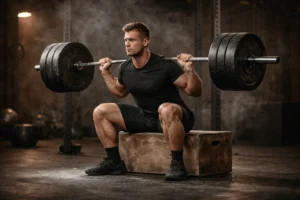
The pause squat (2-second hold) is a highly effective squat variation designed to develop strength, control, and confidence in the bottom position of the squat. By introducing a deliberate pause at depth, this movement removes the stretch reflex and forces the athlete to rely purely on muscular strength and positional integrity to stand back up.
Pause squats are widely used in strength training, Olympic lifting, and hybrid fitness programmes because they improve squat mechanics while exposing weaknesses that are often hidden during faster repetitions. Whether performed with a barbell or bodyweight, the pause squat reinforces proper bracing, balance, and joint alignment under load.
During the pause squat, the athlete descends into a full squat and holds the bottom position for a strict two seconds before initiating the ascent. This pause demands active tension through the quadriceps and glutes while requiring the core and upper back to maintain posture. Over time, this leads to improved squat depth, stronger transitions out of the hole, and better movement efficiency.
Primary muscles worked include the quadriceps and glutes, which are heavily loaded during both the paused position and the concentric drive upward. Secondary muscles such as the hamstrings, adductors, and spinal erectors assist in stabilisation and hip extension, while the core plays a critical role in maintaining bracing throughout the pause.
Pause squats translate well to functional fitness and race-based events where fatigue challenges movement quality. They also pair well with standard squats, front squats, and Olympic lifts by improving positional strength and consistency under load.