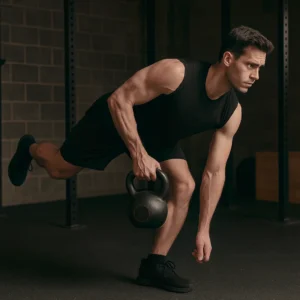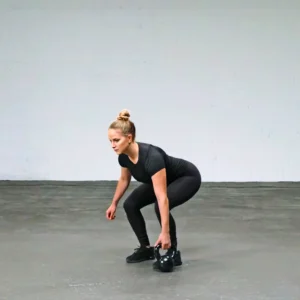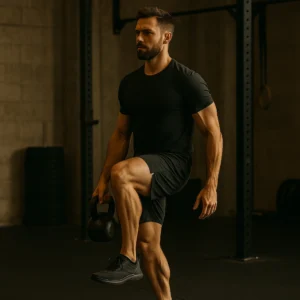

Learn more about Kettlebell Windmill
Exercise Facts
- Movement Pattern Hinge, Lateral Flexion, Overhead Stability, Rotation
- Muscle Group Core, Glutes, Hamstrings, Obliques, Shoulders, Triceps
- Equipment Kettlebell
- Environment Gym, Home
- Skill Level Advanced, Intermediate
Detailed How-To Kettlebell Windmill
The kettlebell windmill is one of the most effective functional movements for training overhead stability, core rotation and hip-controlled hinging. Because the kettlebell windmill loads the body asymmetrically, every rep challenges your ability to stabilise, rotate and move with precision. This makes it especially valuable for athletes who want better shoulder resilience, improved trunk control and stronger multi-plane movement.
The kettlebell windmill begins with the kettlebell locked overhead. From this position, the athlete hinges at the hip, rotates through the trunk and lowers their free hand towards the floor while keeping the kettlebell stacked directly above the shoulder. This encourages strong shoulder stabilisation, a powerful lat connection and deep oblique engagement. The movement also teaches improved hip mobility, which carries over to lunges, carries, sandbag lifts and other exercises within the RB100.Fitness exercise library.
Athletes preparing for HYROX events often overlook rotational stability, yet it plays a key role in controlling movement under fatigue. The kettlebell windmill develops this control exceptionally well. You can also pair it with exercises such as the Kettlebell Snatch, Dumbbell Z Press or Sandbag Over Shoulder to reinforce overhead strength through different planes. For additional guidance on rotational strength, explore the Rotational Power Series inside the RB100 Exercise Library.
External resources such as ACE Fitness and MuscleWiki provide foundational movement insights that align with the kettlebell windmill’s principles of controlled rotation and shoulder stability. You can compare technique cues with similar patterns at:
https://www.acefitness.org/
https://musclewiki.com/
https://darebee.com/
Primary & Secondary Muscles Worked
The kettlebell windmill targets the obliques as the primary rotational stabilisers. The shoulders, especially the deltoids, act as the overhead support mechanism while the glutes and hamstrings drive the hip hinge. The core, lats, triceps and erectors provide rotational control and help prevent collapse under load. Altogether, the movement trains a unique blend of strength, mobility and structural stability.
Because the kettlebell windmill challenges the body across multiple planes, it is an excellent accessory movement for improving balance, structural strength and injury resilience. Whether used in warm-ups, strength blocks or conditioning sessions, it rewards athletes with better movement quality and greater control throughout the entire kinetic chain.