
Learn more about Kettlebell Swings
Exercise Facts
- Movement Pattern Hinge
- Muscle Group Core, Glutes, Hamstrings, Shoulders
- Equipment Kettlebells
- Environment Gym, Home
- Skill Level Beginner, Intermediate
Detailed How-To Kettlebell Swings
The kettlebell swing is a powerful hinge-based movement that develops explosive hip drive, posterior chain strength, and cardiovascular fitness. Unlike squats, which focus on controlled eccentric and concentric motion, swings are ballistic relying on speed and force generated from the hips. This makes them one of the most functional and transferable exercises for athletic performance.
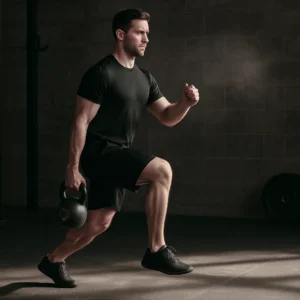
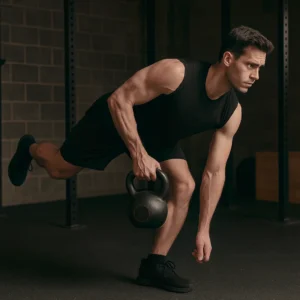
To perform the kettlebell swing, hinge at the hips while keeping a flat back, swing the bell back between the legs, and then explosively extend the hips to drive the kettlebell forward and up to chest height. The arms stay relaxed, acting more like ropes than lifters. Proper execution means the kettlebell “floats” at the top of the movement due to the power of the hip snap.
Swings improve strength endurance, grip strength, and conditioning. They also reinforce correct hip hinging mechanics, which carry over into deadlifts, cleans, and jumps. Athletes benefit from the metabolic demand — a set of 20–30 swings elevates heart rate quickly. For RB100, programming 5×20 swings makes for a punishing but effective 100-rep challenge.
Common errors include squatting instead of hinging, overextending the spine, or lifting with the arms. Correcting these faults ensures safety and maximises power output. Beginners can start with dead-stop swings for better control, while advanced lifters can progress to double kettlebell swings or American swings overhead.
Kettlebell swings can be used for both conditioning and strength. Short interval sets build power and resilience, while longer sets enhance aerobic capacity. Their versatility makes them a staple in both home and gym training.