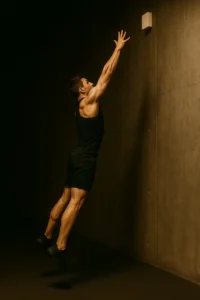

Learn more about Single-Leg Lateral Skater Hop to Stick
Exercise Facts
- Movement Pattern Jump, Landing Control, Lateral, Plyometric, Unilateral
- Muscle Group Calves, Core, Glutes, Hamstrings, Hip Stabilizers, Obliques, Quads
- Equipment Bodyweight
- Environment Gym, Home, Outdoor
- Skill Level Advanced, Intermediate
Detailed How-To Single-Leg Lateral Skater Hop to Stick
The single-leg lateral skater hop to stick is an athletic plyometric drill that trains lateral power, balance, landing strength and dynamic stability. Unlike continuous skater hops, this variation includes a deliberate “stick” or controlled pause at the end of each jump. The stick phase builds proprioception and joint control, making the movement ideal for hybrid athletes and anyone who wants to improve change-of-direction ability, single-leg strength and agility.
The exercise begins by standing on one leg. The athlete then jumps laterally to the opposite side, landing softly and absorbing force through the hip, knee and ankle before pausing in a stable single-leg stance. This pattern strengthens the glute medius, obliques and hip stabilisers, all of which are essential for strong lateral movement. It also reinforces proper knee tracking and landing mechanics — skills that directly support movements like Single-Leg Box Jumps, Lateral Bounds, Depth Drops and even hybrid functional tasks like Bear Crawls and Sled Pushes where stability matters.
Within the rb100.fitness Exercise Library, the single-leg lateral skater hop to stick belongs in the Plyometric Jump Series, the Unilateral Power Series and the Functional Stability Series because it blends explosive intent with controlled landings. This exercise also pairs well with strength movements that develop lateral capacity such as the Lateral Lunge, Copenhagen Plank or Single-Leg Depth Drop to Jump. Introducing this drill into training can improve an athlete’s ability to handle lateral forces, which is often overlooked in sagittal-plane dominant programmes.
For additional external reference, coaching cues and biomechanical insights on jump training can be found at reputable sources such as:
https://www.acefitness.org/
https://www.fitnessblender.com/
https://musclewiki.com/
Primary & Secondary Muscles Worked
The primary muscles involved are the glutes, quads and calves, which work together to generate explosive push-off and manage force absorption during the landing. The glute medius plays a particularly important role by stabilising the hip and knee in the frontal plane. Secondary muscles include the hamstrings, obliques and deeper hip stabilisers, which maintain balance and control during both the jump and the stick phase.
Overall, the single-leg lateral skater hop to stick is a highly functional drill that improves athletic control, joint stability and explosive movement. It is a versatile exercise suitable for strength sessions, speed development blocks or conditioning sequences where technique and control matter as much as power.