
Single-Leg Lateral Box Jump
A unilateral plyometric drill developing lateral power, balance, and stability by jumping sideways from one leg onto a box.
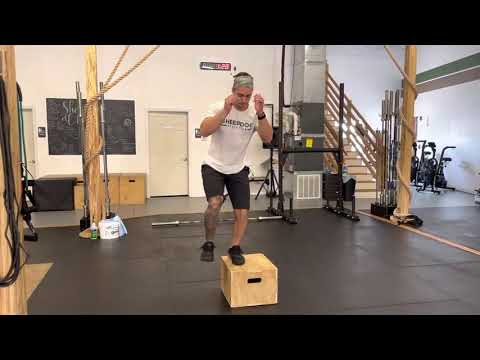
Setup
- Stand to the side of a plyo box on one leg; brace core; bend slightly at knee and hip; keep gaze forward.
Execution
- Drive laterally from stance leg; swing arms to generate force; land softly on same leg atop the box; stabilize and reset.
Coaching cues
- Drive from the hip.
- Land soft.
- Control the catch.
Common faults & fixes
- Hopping instead of jumping → fully extend through hip and ankle.
- Knee collapse → engage glutes for alignment.
- Landing stiff → absorb through leg and hip.
Regressions
- Low box height, step-up to balance, or side jump to floor without box.
Variations
- Alternating single-leg lateral jumps, single-leg depth drop to lateral box, or two-leg to single-leg landings.
Programming ideas
- 3–5×3–5 reps per leg; use early in plyometric sessions or as part of agility training blocks.
Safety
Use stable, non-slip box; start low and progress height gradually; avoid twisting under fatigue.
Competition standards
Controlled lateral drive; stable single-leg landing; minimal ground contact; symmetrical movement both sides.
In depth
The Single-Leg Lateral Box Jump is an advanced plyometric exercise designed to build explosive power and balance in the frontal plane. By pushing off one leg and jumping laterally onto a raised platform, athletes develop the ability to generate force sideways — a critical skill for agility, coordination, and overall athletic movement.
To perform, stand to the side of a stable plyo box, balancing on your inside leg. Engage your core, bend slightly at the hips and knee, and swing your arms for momentum. Explosively drive off your stance leg, propelling yourself laterally onto the box. Land softly on the same leg, absorbing the force through your hip, knee, and ankle. Hold for a second to stabilize before stepping down and resetting for the next rep.
This movement targets the glutes, adductors, abductors, quads, hamstrings, and core, enhancing both power and joint stability. The lateral force vector challenges balance and proprioception, making it a valuable addition for athletes who rely on side-to-side agility — from runners and skiers to team sport players.
Common faults include hopping rather than jumping, collapsing the knee inward, or landing stiff-legged. Cue “drive from the hip,” “land soft,” and “control the catch.”
At Relentless Bravery Fitness, the Single-Leg Lateral Box Jump represents mastery through precision and control — strength expressed in motion across all planes.
Program 3–5 sets of 3–5 reps per leg, resting 60–90 seconds between efforts to ensure quality execution.
Keep training
Related exercises

Single-Leg Alternating Lateral Box Bounds
Shared: Abductors, Adductors, Calves, Core, Glutes, Hamstrings, Quads, Floor Mat, Plyo Box, Jump, Lateral, Plyometric, Power, Unilateral
Single-Leg Box Hop to Lateral Bound
Shared: Abductors, Adductors, Calves, Core, Glutes, Hamstrings, Quads, Floor Mat, Plyo Box, Jump, Lateral, Plyometric, Power, Unilateral

Single-Leg Box Hop to Lateral Bound & Return
Shared: Abductors, Adductors, Calves, Core, Glutes, Hamstrings, Quads, Floor Mat, Plyo Box, Jump, Lateral, Plyometric, Power, Unilateral

Single-Leg Continuous Lateral Bounds to Box
Shared: Abductors, Adductors, Calves, Core, Glutes, Hamstrings, Quads, Floor Mat, Plyo Box, Jump, Lateral, Plyometric, Power, Unilateral

Single-Leg Depth Drop to Lateral Bound
Shared: Abductors, Adductors, Calves, Core, Glutes, Hamstrings, Quads, Floor Mat, Plyo Box, Jump, Lateral, Plyometric, Power, Unilateral
Single-Leg Depth Drop to Lateral Bound & Return
Shared: Abductors, Adductors, Calves, Core, Glutes, Hamstrings, Quads, Floor Mat, Plyo Box, Jump, Lateral, Plyometric, Power, Unilateral