
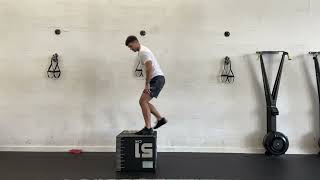
Single-Leg Lateral Bound to Box
A single-leg plyometric movement combining lateral and vertical power, bounding sideways onto a box for balance and explosive control.

Setup
- Stand on one leg beside a box; hinge slightly at hips; brace core; swing arms and opposite leg to prepare for a lateral bound.
Execution
- Explosively drive sideways from stance leg; land softly on same leg atop box; stabilize posture before stepping down.
Coaching cues
- Drive laterally.
- Land tall.
- Stick the landing.
Common faults & fixes
- Jumping with both legs → isolate single-leg push.
- Knee collapse → engage glutes for alignment.
- Losing balance → reduce box height or speed.
Regressions
- Lateral step-up to balance, side hop on floor, or lower box height.
Variations
- Alternating bounds, continuous side-to-side bounds, or lateral bound to target instead of box.
Programming ideas
- 3–5×3–5 reps per leg; use early in plyometric sessions; pair with lateral lunges or single-leg RDLs.
Safety
Ensure stable box and clear side area; avoid excessive distance; prioritize technique and soft landings.
Competition standards
Single-leg takeoff and landing; lateral control maintained; minimal torso deviation; equal reps per side.
In depth
The Single-Leg Lateral Bound to Box is an advanced plyometric movement that combines horizontal and vertical power, challenging single-leg strength, balance, and coordination. It’s a staple in athletic performance training and functional movement development, improving both lateral explosiveness and control upon landing.
To perform, stand on one leg beside a stable plyo box or platform (12–24 inches high). Engage your core and hinge slightly at the hip, loading your stance leg. Swing your arms and opposite leg to generate lateral momentum, then explode sideways off your standing leg, landing softly on the same leg atop the box. Absorb the landing through the ankle, knee, and hip, holding the position for a second before stepping down and resetting.
This exercise primarily targets the glutes, hamstrings, quads, adductors, abductors, and core, while enhancing balance and reactive control. It’s especially effective for athletes seeking to improve side-to-side agility, jump control, and unilateral coordination — skills that transfer directly to sprinting, cutting, and sport-specific performance.
Common mistakes include jumping off both legs, collapsing the knee inward, or losing posture during the landing. Cue “drive laterally,” “land tall,” and “stick the landing.”
In Relentless Bravery Fitness, the Single-Leg Lateral Bound to Box represents the refinement of movement — explosive strength paired with balance and awareness.
Program 3–5 sets of 3–5 reps per leg, resting 60–90 seconds between sets for optimal precision and power.
Keep training
Related exercises

Single-Leg Alternating Lateral Box Bounds
Shared: Abductors, Adductors, Calves, Core, Glutes, Hamstrings, Quads, Floor Mat, Plyo Box, Jump, Lateral, Plyometric, Power, Unilateral
Single-Leg Box Hop to Lateral Bound
Shared: Abductors, Adductors, Calves, Core, Glutes, Hamstrings, Quads, Floor Mat, Plyo Box, Jump, Lateral, Plyometric, Power, Unilateral

Single-Leg Box Hop to Lateral Bound & Return
Shared: Abductors, Adductors, Calves, Core, Glutes, Hamstrings, Quads, Floor Mat, Plyo Box, Jump, Lateral, Plyometric, Power, Unilateral

Single-Leg Continuous Lateral Bounds to Box
Shared: Abductors, Adductors, Calves, Core, Glutes, Hamstrings, Quads, Floor Mat, Plyo Box, Jump, Lateral, Plyometric, Power, Unilateral

Single-Leg Depth Drop to Lateral Bound
Shared: Abductors, Adductors, Calves, Core, Glutes, Hamstrings, Quads, Floor Mat, Plyo Box, Jump, Lateral, Plyometric, Power, Unilateral
Single-Leg Depth Drop to Lateral Bound & Return
Shared: Abductors, Adductors, Calves, Core, Glutes, Hamstrings, Quads, Floor Mat, Plyo Box, Jump, Lateral, Plyometric, Power, Unilateral