
Single-Leg Box Hop to Lateral Bound & Return
An advanced single-leg plyometric movement combining hops and lateral bounds in both directions to build reactive power, control, and rhythm.

Setup
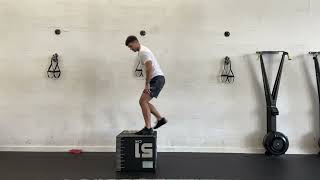
- Stand on one leg atop a low box; brace your core; maintain posture; prepare for a small single-leg hop.
Execution
- Hop vertically on the box; explode laterally to the floor landing on opposite leg; absorb and rebound back to the box; repeat rhythmically.
Coaching cues
- Hop tall.
- Land soft.
- Rebound quick.
- Stay centered.
Common faults & fixes
- Pausing between bounds → focus on seamless rhythm.
- Knee collapse → drive through glutes.
- Heavy landings → increase hip flexion and soft control.
Regressions
- Single-leg box hop only, single-leg hop to bound (one direction), or step-off to bound and reset.
Variations
- Box height changes, tempo holds, or alternating hop-to-bound sequences.
Programming ideas
- 3–4×4–6 full cycles per leg; use in advanced plyometric sessions; combine with depth drops for reactive contrast work.
Safety
Ensure stable box and clear side space; use low box until proficient; prioritize posture and balance over distance.
Competition standards
Controlled hop and bound with minimal pause; stable landing each direction; symmetry both sides.
In depth
The Single-Leg Box Hop to Lateral Bound & Return is an advanced plyometric drill combining vertical and horizontal power with directional rhythm and stability. It challenges the athlete to hop vertically on one leg, bound laterally off a box, land, and immediately rebound back to the starting position training both deceleration and reacceleration.
To perform, stand on one leg atop a low, stable plyo box (8–12 inches). Engage your core, maintain upright posture, and balance. Begin with a small single-leg hop on the box, then explode laterally off the same leg to bound sideways to the floor, landing softly on the opposite leg. Upon landing, absorb the force through your hip and knee, then immediately rebound back toward the box, landing lightly on the original leg atop the box.
This drill trains coordination, reactivity, and balance across planes of motion. It strengthens the glutes, quads, hamstrings, calves, adductors, abductors, and core, while improving agility, proprioception, and rhythm.
Common faults include pausing between movements, collapsing at the knee, or overreaching. Cue “hop tall,” “stay centered,” and “land soft, rebound quick.”
At Relentless Bravery Fitness, this exercise represents mastery of movement under changing direction stability and control forged through motion.
Program 3–4 sets of 4–6 full cycles per leg, resting 90 seconds between sets. Focus on seamless transitions and posture control.
Keep training
Related exercises

Single-Leg Alternating Lateral Box Bounds
Shared: Abductors, Adductors, Calves, Core, Glutes, Hamstrings, Quads, Floor Mat, Plyo Box, Jump, Lateral, Plyometric, Power, Reactive, Rhythm, Unilateral

Single-Leg Depth Drop to Lateral Bound & Return
Shared: Abductors, Adductors, Calves, Core, Glutes, Hamstrings, Quads, Floor Mat, Plyo Box, Jump, Lateral, Plyometric, Power, Reactive, Rhythm, Unilateral

Single-Leg Lateral Bound to Vertical Jump & Return
Shared: Abductors, Adductors, Calves, Core, Glutes, Hamstrings, Quads, Floor Mat, Jump, Lateral, Plyometric, Power, Reactive, Rhythm, Unilateral
Single-Leg Box Hop to Lateral Bound
Shared: Abductors, Adductors, Calves, Core, Glutes, Hamstrings, Quads, Floor Mat, Plyo Box, Jump, Lateral, Plyometric, Power, Reactive, Unilateral

Single-Leg Continuous Lateral Bounds to Box
Shared: Abductors, Adductors, Calves, Core, Glutes, Hamstrings, Quads, Floor Mat, Plyo Box, Jump, Lateral, Plyometric, Power, Reactive, Unilateral

Single-Leg Depth Drop to Lateral Bound
Shared: Abductors, Adductors, Calves, Core, Glutes, Hamstrings, Quads, Floor Mat, Plyo Box, Jump, Lateral, Plyometric, Power, Reactive, Unilateral