
Learn more about Sandbag Zercher Lunge
Exercise Facts
- Movement Pattern Core Stability, Functional Strength, Lunge, Unilateral
- Muscle Group Core, Erectors, Glutes, Hamstrings, Quads
- Equipment Sandbag
- Environment Gym, Outdoor
- Skill Level Advanced, Beginner, Intermediate
Detailed How-To Sandbag Zercher Lunge
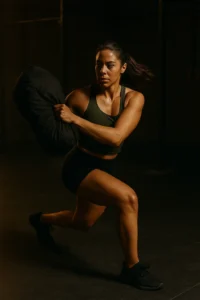
The Sandbag Zercher Lunge is a unilateral lower-body exercise that develops strength, stability, and balance while reinforcing posture and core engagement. By holding the sandbag in the crook of the elbows, the load shifts slightly forward, forcing the athlete to maintain an upright torso and tight core throughout each step. This variation trains both the lower body and upper body under tension, improving coordination and control.
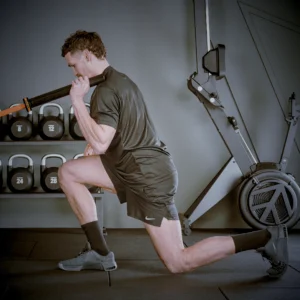
To perform, start by lifting the sandbag into a Zercher position held securely in the crease of the elbows, with your hands clasped together in front of your chest. Stand tall with your feet hip-width apart, chest up, and core braced. Step forward into a lunge, lowering your back knee toward the ground while keeping your front knee tracking over your toes. Push through the heel of your front foot to return to standing, maintaining control and balance throughout. Repeat on the other leg, alternating sides or performing all reps on one side before switching.
The Sandbag Zercher Lunge targets the quads, glutes, hamstrings, erectors, and core, while the forward load challenges posture and stabilisation. The sandbag’s shifting weight amplifies the need for balance, coordination, and bracing ideal for athletes training for real-world performance and hybrid strength.
Common mistakes include leaning forward, collapsing the chest, or stepping too narrow. Cue “stay tall,” “brace tight,” and “drive through the heel.”
In Relentless Bravery Fitness, the Sandbag Zercher Lunge represents composure through challenge each step controlled, balanced, and purposeful.
Program 3–4 sets of 8–10 reps per leg for strength and control, or use lighter loads for higher-volume endurance work.
What muscles do Sandbag Zercher Lunge work?
Primary Muscles Worked
- Quadriceps: The primary movers responsible for knee extension as you push back up from the lunge position.
- Glutes (Gluteus Maximus and Medius): Play a major role in hip extension and power generation, particularly as you drive through the front heel.
- Hamstrings: Assist in stabilizing the knee joint and controlling the descent during the movement.
Secondary and Stabilizer Muscles
- Core (Abdominals and Obliques): The anterior load of the sandbag in the crook of your elbows forces intense core engagement to prevent the body from being pulled forward and maintain an upright, stable posture.
- Erector Spinae: These lower and middle back muscles work hard to keep your spine from rounding under the anterior load.
- Upper Back (Trapezius, Rhomboids, Rear Deltoids): These muscles are constantly activated to hold the sandbag securely in the crook of your elbows and maintain shoulder position against the forward pull of the weight.
- Biceps: Involved in maintaining the static hold of the sandbag.
- Calves: Act as dynamic stabilizers during the movement.
- Hip Rotators and other Stabilizers: The unilateral nature of the lunge requires significant balance and coordination, engaging smaller stabilizing muscles around the hips and knees to control movement.
The combination of the lunge pattern and the Zercher hold makes this a challenging, full-body functional exercise that builds strength, stability, and balance.