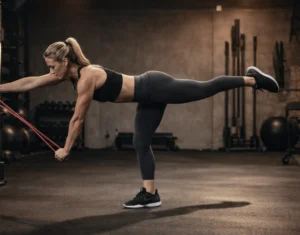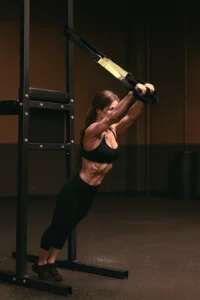

Learn more about Resistance Band Pallof Press Hold
Exercise Facts
- Movement Pattern Anti-Rotation, brace, Core
- Muscle Group abdominals, Glutes, Obliques, spinal-erectors
- Equipment cable, resistance-band
- Environment Gym, Home, Outdoor
- Skill Level Beginner, Intermediate
Detailed How-To Resistance Band Pallof Press Hold
What is the Resistance Band Pallof Press Hold?
The Resistance Band Pallof Press Hold is an essential anti-rotation core drill that strengthens your ability to resist unwanted movement, a key component of both athletic performance and daily function. Because the focus of the Pallof Press Hold is resisting rotation, it challenges the obliques, abdominals and deep stabilisers of the spine. This makes it extremely relevant for anyone training for events such as HYROX, where trunk stability under fatigue directly influences performance during running, sled work and wall balls.
Unlike high-repetition abdominal exercises, the Resistance Band Pallof Press Hold develops real-world strength. It builds the ability to maintain posture and alignment, which supports efficiency in movements like the Farmer’s Carry and Dumbbell Lunges. This is why the Pallof Press has become a trusted exercise across strength and conditioning, physiotherapy and endurance training.
Why the Pallof Press Hold Works
What makes the Resistance Band Pallof Press Hold so effective is the isometric nature of the movement. Unlike many core exercises that involve flexion, rotation or side bending, the Pallof Press Hold is about resisting those forces. By stepping sideways from the anchor point and pressing the band out in front of you, the band tries to rotate your torso back toward the anchor. Your job is simple: do not move.
If you want to understand the basic patterns of core training, it is helpful to explore anti-rotation, anti-extension and anti-lateral flexion work. This exercise falls firmly into the anti-rotation category, similar to movements like the Landmine Anti-Rotation Press and cable-based stability drills found in strength programmes from organisations such as ACE Fitness and Muscle & Strength.
External link for reference:
https://www.acefitness.org/exercise-library/
How to Perform the Resistance Band Pallof Press Hold
To perform the exercise correctly, attach a resistance band to a sturdy anchor point at chest height. Step sideways until the band is taut, position your feet about hip-width apart and press the handles straight out in front of you. The objective is to maintain a stable trunk and prevent rotation for the duration of the hold.
Remember that your glutes play an important role in providing pelvis and hip stability, so expect to feel them engage as you maintain your stance. Your lats and spinal erectors also contribute by helping lock the torso into a strong, neutral position.
Primary and Secondary Muscles Worked
Primary muscles: Obliques and abdominals
These muscles work isometrically to resist rotation and maintain trunk alignment.
Secondary muscles: Glutes, spinal erectors, lats
These stabilise the pelvis and spine to prevent compensatory movements elsewhere.
If you want a more advanced variation that builds on this pattern, consider pairing the Pallof Press Hold with dynamic versions such as the Pallof Press Walkout or adding rotation-resisting footwork patterns similar to hybrid functional sessions used in RB100.Fitness programming.
When to Use This in Training
The Resistance Band Pallof Press Hold fits well in warm-ups, accessory blocks or core conditioning sections. For HYROX athletes, it is especially useful for reinforcing posture for the Sled Push, Sled Pull and running segments that rely heavily on trunk stiffness.
For additional core-focused learning, explore movement guides on MuscleWiki and functional stability resources on Functionalyoga.uk, which complement the stability principles found in the Pallof Press movement.