
Learn more about Sandbag Ground-to-Overhead
Exercise Facts
- Movement Pattern Functional Strength, Hinge, Power, Press, Total Body
- Muscle Group Back, Core, Glutes, Hamstrings, Quads, Shoulders, Triceps
- Equipment Sandbag
- Environment Gym, Outdoor
- Skill Level Advanced, Beginner, Intermediate
Detailed How-To Sandbag Ground-to-Overhead
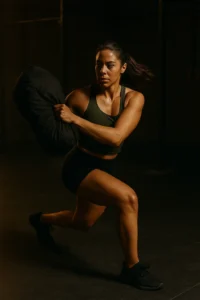
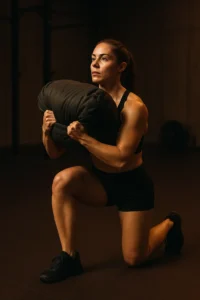
The Sandbag Ground-to-Overhead is a foundational power movement that challenges nearly every muscle group in the body. It teaches efficient energy transfer from the ground through the hips, core, and shoulders developing total-body strength, coordination, and explosive drive. This exercise is a perfect representation of real-world functional strength and a key movement pattern used in hybrid training and HYROX-style workouts.
To perform, start with the sandbag on the floor between your feet. Hinge at the hips and squat slightly to grip the sides or handles of the bag with both hands. Brace your core and keep your chest up. Drive through your legs and hips to lift the sandbag off the floor, then continue the upward motion by extending the hips and pulling the sandbag close to your body. Transition smoothly into a front-rack position, then press or jerk the sandbag overhead until your arms are fully extended and stable. Lower the sandbag back to your chest and then to the floor under control.
The Sandbag Ground-to-Overhead targets the glutes, hamstrings, quads, shoulders, triceps, back, and core, promoting power, coordination, and balance. The unstable load of the sandbag forces the stabilising muscles to engage throughout the entire lift, making it an excellent tool for functional performance and athletic conditioning.
Common mistakes include relying too much on the arms, rounding the back, or failing to coordinate the press phase. Cue “drive with the hips,” “keep the bag close,” and “finish tall.”
In Relentless Bravery Fitness, the Sandbag Ground-to-Overhead represents the complete athlete capable of moving efficiently, powerfully, and with unwavering control.
Program 4–6 sets of 3–6 reps for strength and power, or lighter loads with higher reps for conditioning circuits and endurance training.