

Couplet
A couplet is a workout format that combines two exercises performed together.
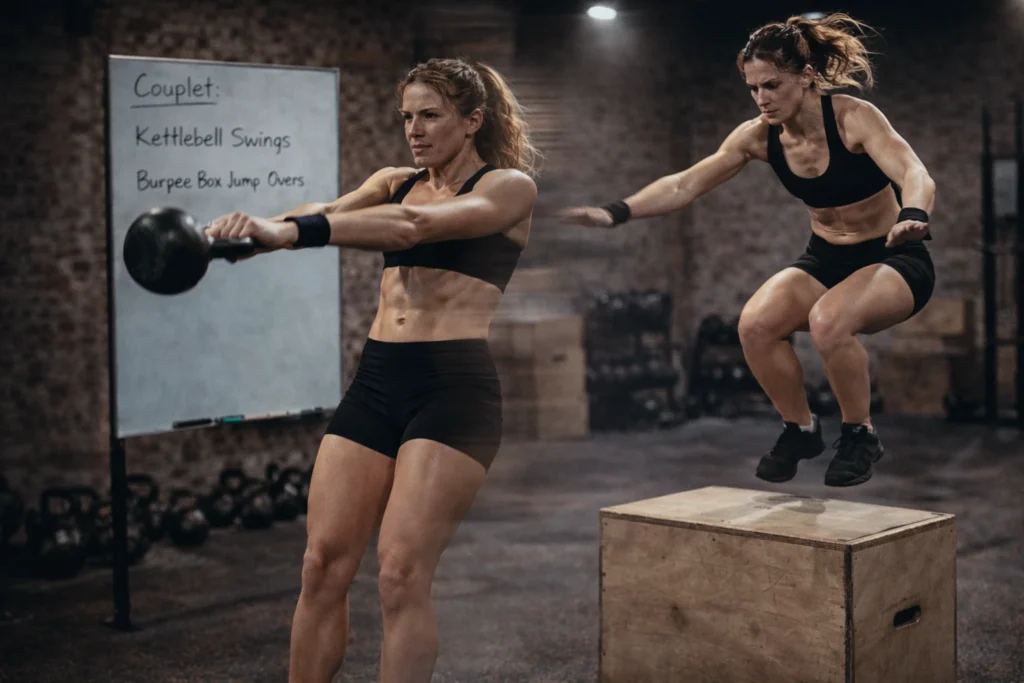
A couplet is a workout made up of two movements that are performed in sequence. The pair is usually repeated for rounds, time, or within a set structure.
Deeper explanation
Couplet workouts pair two exercises to create a specific training stimulus. Movements may target similar muscle groups to increase fatigue or opposing patterns to allow partial recovery between exercises.
The simplicity of a couplet allows athletes to focus on pacing, movement efficiency, and breathing. Couplet structures are highly versatile and can be adapted to aerobic, strength, or mixed-modality training.
Why it matters
Couplets are effective because they are easy to understand yet challenging to execute well. They expose weaknesses in pacing and technique while allowing clear focus on movement quality.
For coaches, couplets provide a flexible framework that can be scaled easily and repeated over time to track progress.
Programming use
Couplets are commonly programmed as AMRAPs, For Time workouts, ladders, or interval sessions. Exercise selection determines the primary stimulus, whether aerobic conditioning, strength endurance, or skill development.
Pairing complementary movements helps manage fatigue, while pairing similar movements increases challenge and intensity.
HYROX / hybrid context
Couplet-style workouts are frequently used in hybrid training to simulate repeated race demands. Examples include pairing running with a functional movement or combining two machine-based efforts.
This structure helps athletes practise transitions, pacing, and recovery between different movement types.
Examples
• Thrusters and pull-ups
• Running and wall balls
• Kettlebell swings and burpees
Quick answers & tooltips
-
Does a couplet always have two exercises?
Yes. That defines the format.
-
Are couplets versatile?
Yes. They can target many training qualities.
Common mistakes & fixes
Poor movement pairing
Pairing two highly technical or fatiguing movements can cause breakdown. Balance difficulty and intent.
Treating all couplets as max-effort
Not every couplet should be raced. Match effort to session goals.
Ignoring rest strategy
Rest placement affects output. Plan rest deliberately rather than reacting to fatigue.
FAQ
Are couplets always repeated?
Often yes, but they can also be used as single-round formats like chippers.
Can couplets be strength-focused?
Yes. Heavy lifts paired together can form effective strength couplets.
Are couplets beginner-friendly?
Yes, when movements and volume are scaled appropriately.