
Mountain Climbers
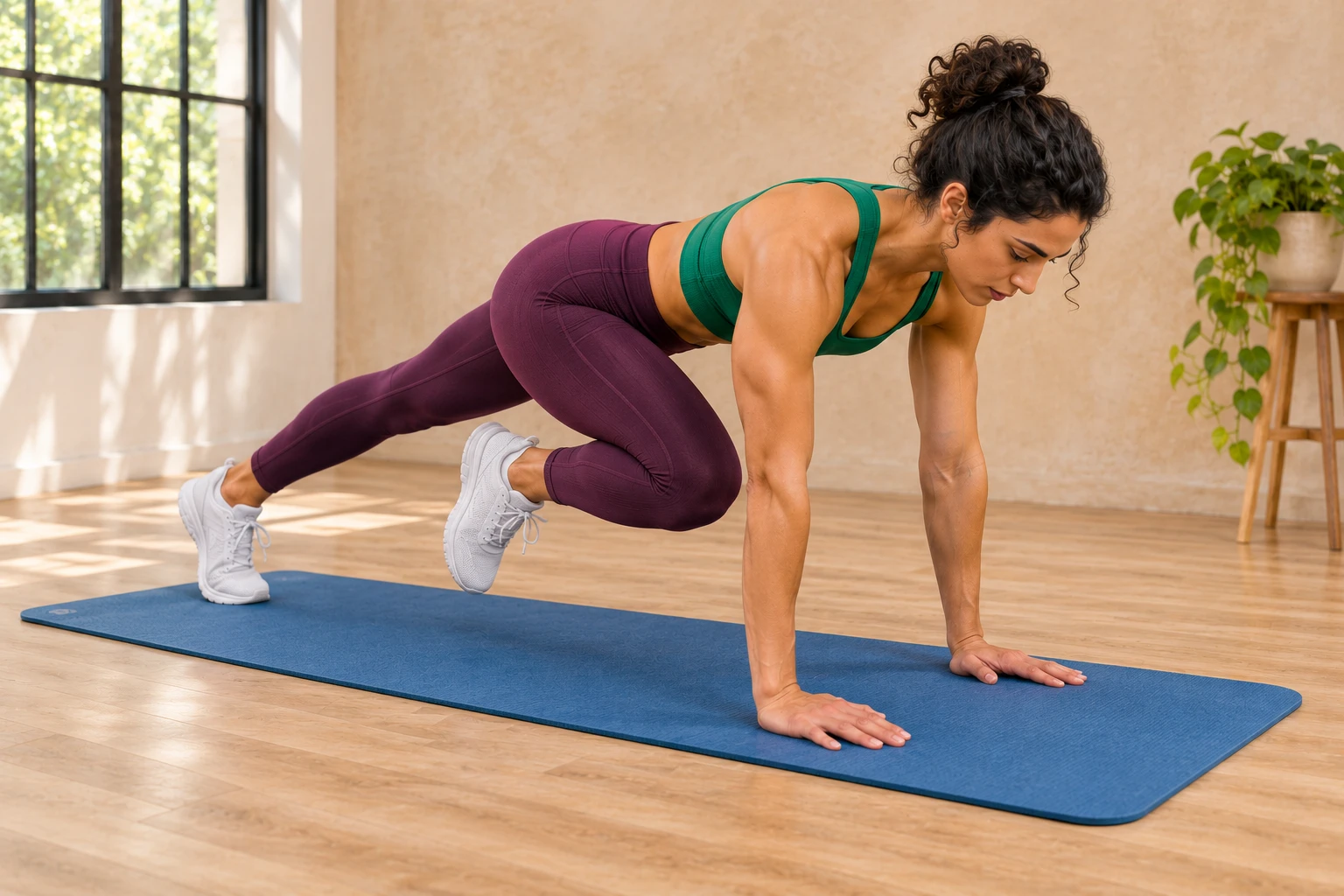
Alternate knee drives from a high plank to challenge trunk stability, shoulder support and conditioning without external load.

Setup
- Choose a level, non-slip surface with enough space to extend both legs behind you.
- Place your palms beneath your shoulders, spread your fingers and push firmly through your hands.
- Step your feet back into a high plank, keeping your head, trunk and pelvis aligned.
- Brace your abdomen and gently squeeze your glutes before moving either leg.
Execution
- Lift one foot and draw that knee towards your chest without rounding your back or lifting your hips.
- Stop the knee drive before your pelvis tucks or your shoulders shift noticeably behind your hands.
- Return the foot to its starting position under control.
- Repeat with the opposite leg, keeping your chest supported between your arms.
- Continue alternating while breathing steadily; increase cadence only if your trunk remains controlled.
Coaching cues
- Push the floor away throughout the set.
- Bring the knee forward; do not chase it with your chest.
- Keep your hips near shoulder height rather than piking upwards.
- Make quiet, controlled foot contacts.
- Keep breathing instead of holding your breath through the interval.
Common faults & fixes
- Hips bouncing upwards: slow the leg switches and shorten the knee drive until your pelvis stays steady.
- Lower back sagging: reset your brace, reduce the set duration or raise your hands onto a stable bench.
- Shoulders drifting behind the wrists: re-establish hands beneath shoulders and avoid pushing yourself backwards with each leg drive.
- Feet slipping or landing heavily: use a grippier surface and return to deliberate step-by-step repetitions.
Regressions
- Bench-supported mountain climbers: place both hands on a secure bench and alternate controlled knee drives.
- Slow floor mountain climbers: return one foot fully before lifting the other, removing the rapid switching action.
- Reduced-range mountain climbers: draw each knee forward only as far as you can without changing your trunk position.
Variations
- Cross-body mountain climbers: direct each knee towards the opposite elbow while limiting unnecessary pelvic rotation.
- Paused mountain climbers: hold each knee-forward position briefly without collapsing through your shoulders.
- Running mountain climbers: switch legs more quickly for a greater conditioning demand while maintaining a steady upper body.
Programming ideas
- Technique practice: perform 3 sets of 6–10 controlled knee drives per side, resting long enough to reset your position.
- Warm-up accessory: complete 2–3 rounds of 15–20 seconds at an easy cadence before more demanding bodyweight work.
- Conditioning finisher: try 4–6 rounds of 20 seconds working and 40 seconds resting; stop each interval early if trunk control deteriorates.
Safety
Use a non-slip surface and ensure any bench cannot slide or tip. End the set when you can no longer prevent hip bouncing, lower-back sagging or shoulder collapse. Stop for wrist, shoulder or back pain, dizziness or unusual breathlessness rather than pushing through. If an existing medical condition or persistent symptoms affect your ability to bear weight through your hands, seek clinician review before using this exercise.
In depth
Why use mountain climbers in hybrid training?
Mountain climbers ask your trunk to resist excessive lower-back extension while your legs move underneath you. Your shoulders support your body throughout, making this a useful combination of limb movement and positional control. Unlike standing running drills, the hands-supported position adds an upper-body support demand without requiring external load.
When should you programme them?
Use slow repetitions during a warm-up to practise bracing, or short intervals after your main session for additional conditioning. Avoid exhausting your shoulders immediately before technical pressing or burpee practice. For HYROX athletes, mountain climbers fit best as an accessory: they offer convenient bodyweight work but do not replace running volume, sled practice or other race-specific preparation.
+Should mountain climbers be fast or slow?
+Are mountain climbers useful for HYROX training?
+How can beginners scale mountain climbers?
Keep training
Related exercises

Burpee Broad Jump
Shared: Core, Shoulders, Bodyweight, Conditioning

Burpee to Target Jump (Hybrid Plyometric)
Shared: Core, Shoulders, Bodyweight, Conditioning

Hanging Knee Raise
Shared: Core, Hip Flexors, Shoulders

Air Bike (Assault Bike)
Shared: Core, Shoulders, Conditioning

Battle Ropes
Shared: Core, Shoulders, Conditioning

Dumbbell Front Rack Walking Lunge
Shared: Core, Shoulders, Conditioning