
Glossary

Bracing

Bracing

Pronounced: BRAY-sing

Bracing is the coordinated tightening of muscles around your trunk to increase stiffness and control movement under load. Rather than sucking your stomach in, you create tension around your midsection. Athletes use bracing during squats, deadlifts, carries and other movements to help transfer force while maintaining a controlled position.

Definition

Bracing is the coordinated activation of muscles around the trunk to increase its stiffness and resist unwanted movement. It involves the abdominal wall and back muscles, working alongside the diaphragm and pelvic floor to manage pressure and support control under load.

Why it matters

Your trunk connects the forces produced by your legs and upper body. Appropriate bracing helps you maintain the position needed for a lift, carry or push without excessive bending, arching or rotation. It is a movement skill, not a guarantee against injury or a substitute for choosing a manageable load.

Deeper explanation

Bracing combines muscular tension with pressure within the abdominal cavity. The aim is not to make the spine completely immobile, but to provide enough stiffness for the task. A squat, an overhead press and a farmer’s carry place different demands on the trunk. Useful tension therefore changes with the load, direction of force and duration of effort.

How to programme it

Practise bracing during warm-up sets rather than adding fatigue before your main lifts. For example, perform two sets of five light goblet squats, establishing trunk tension before each descent and resetting between repetitions if needed. Progress the load only while you can maintain the intended movement and breathing pattern.

In HYROX and hybrid racing

Bracing supports trunk control during sled pushes, sled pulls, farmer’s carries, sandbag lunges and wall balls. During a farmer’s carry, use enough tension to limit unwanted side-to-side movement while continuing to breathe. Across longer stations, avoid treating every repetition like a maximal lift: sustainable breathing matters alongside stability.

FAQs

+Is bracing the same as sucking your stomach in?
No. Bracing involves coordinated tension around the trunk. Drawing the abdomen inward is a different action, often called abdominal hollowing. For loaded squats and carries, think about firming your whole midsection rather than narrowing your waist.
+Do you need to hold your breath when bracing?
Not always. You can brace while breathing, particularly during carries and repeated moderate-load movements. A deliberate breath-hold used during heavy lifting is a separate strategy called the Valsalva manoeuvre; it is not required for practising basic bracing and can produce substantial blood-pressure changes.
+Should you brace as hard as possible throughout a workout?
No. Match the tension to the task. A heavy lift generally demands more trunk stiffness than easy running. Maintaining maximal tension unnecessarily can make breathing and movement harder, particularly during longer efforts.

Also known as: abdominal bracing, trunk bracing, core bracing

How does bracing work in practice?

Bracing means making your trunk firm enough to handle the force of a movement. Think of preparing your midsection for a gentle nudge without pulling your stomach inward or lifting your chest into an exaggerated arch.

How can you practise it?

  • Stand comfortably with your ribcage broadly over your pelvis, rather than forcing a rigid posture.
  • Take a comfortable breath, allowing your lower ribs and abdomen to expand.
  • Firm your midsection around the front, sides and back. Keep your shoulders relaxed.
  • Maintain that tension while taking small, controlled breaths.
  • Try a bodyweight squat or light carry. Reduce the effort if you cannot coordinate breathing and movement.
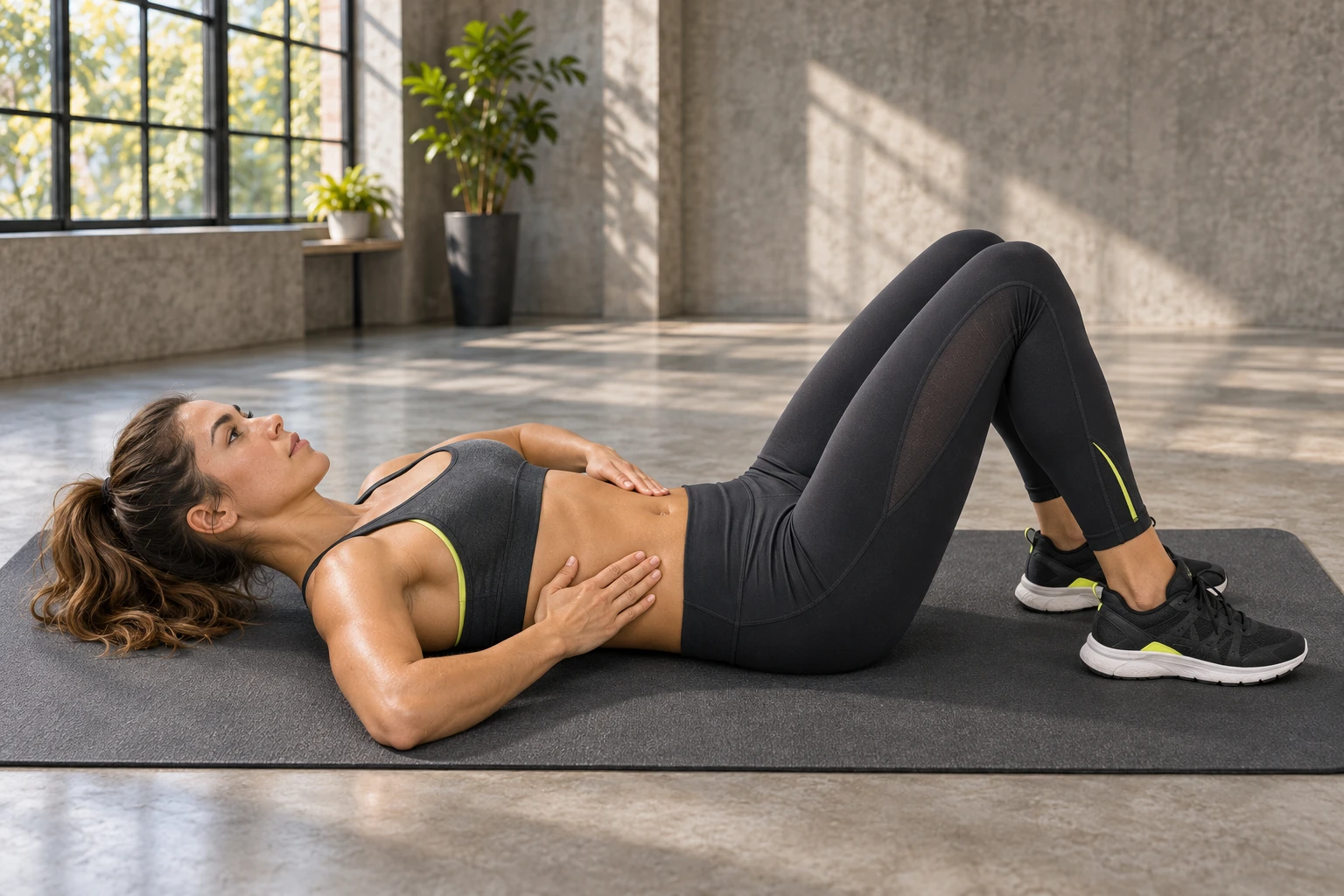
Athlete lies with knees bent and feet grounded, placing her hands around her waist to practise bracing.

How should you scale loaded movements?

  • Goblet squat: reduce the weight or use a box to establish a repeatable depth you can control.
  • Deadlift: reduce the load or raise the starting position on stable blocks if you cannot maintain your intended trunk position from the floor.
  • Farmer’s carry: use lighter implements and shorter distances if you start leaning or cannot keep breathing steadily.
  • Wall ball: choose a lighter ball and shorter sets if fatigue causes repeated loss of balance or uncontrolled trunk movement.

When should you stop?

End the set when you can no longer control the movement or restore your breathing between repetitions. Stop exercising if you develop sharp or worsening pain, dizziness, chest discomfort or unusual breathlessness. Seek qualified medical advice for concerning or recurring symptoms, and urgent help for severe symptoms. If you have been advised to avoid straining or breath-holding, get individual guidance before heavy lifting.