
Hollow Body Hold
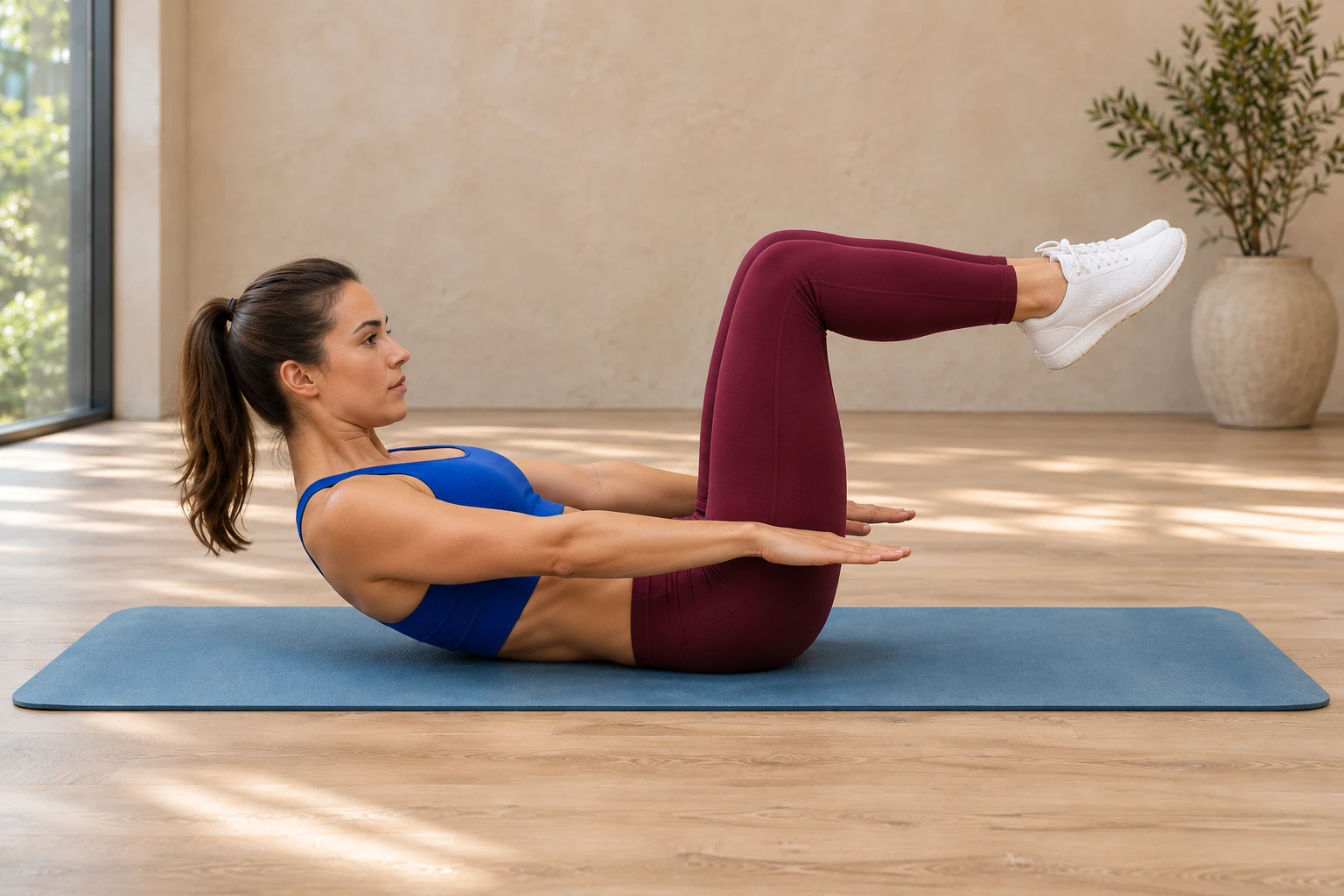
A static floor exercise that challenges abdominal control by extending the arms and legs while keeping the lower back gently pressed into the mat.

Setup
- Lie on your back on an exercise mat with your knees bent and feet flat.
- Reach your arms towards your thighs and keep your neck relaxed.
- Exhale and gently tilt your pelvis so your lower back contacts the mat.
- Lift your feet, bringing your hips and knees to roughly right angles.
Execution
- Lift your head and shoulder blades slightly, keeping a small gap between your chin and chest.
- Extend your legs forwards and upwards, then lower them only as far as you can maintain lower-back contact.
- Reach your arms overhead if you can do so without lifting your ribs or arching your back; otherwise keep them beside your thighs.
- Hold the position while taking small, steady breaths rather than holding your breath.
- Finish by bending your knees, bringing your arms forwards and lowering your shoulders and feet under control.
Coaching cues
- Keep your lower back heavy against the mat.
- Reach long through your fingertips and toes.
- Keep your ribs drawn towards your pelvis.
- Choose a shorter lever before your back starts to arch.
- Breathe throughout; do not turn the hold into a breath-holding test.
Common faults & fixes
- Lower back lifting: raise your legs or bend your knees until contact is restored.
- Ribs lifting when the arms reach overhead: bring your arms back beside your thighs.
- Chin pushed forwards or neck straining: reduce the shoulder lift; if discomfort persists, stop and use a head-supported regression.
- Shaking followed by loss of position: shorten the set and rest rather than extending the hold with poor control.
Regressions
- Tucked hollow hold: keep both knees bent and your arms reaching beside your thighs.
- Single-leg extension hold: keep one knee tucked while extending the other leg; alternate sides between sets.
- Head-supported bent-knee brace: rest your head on the mat with hips and knees bent, maintaining lower-back contact and steady breathing.
Variations
- Arms-overhead hollow hold: move the arms from your sides towards your ears without changing your trunk position.
- Hollow body rock: maintain the same curved shape while rocking gently forwards and backwards; avoid kicking to generate momentum.
- Hollow flutter kicks: alternate small leg movements while keeping your pelvis still and lower back against the mat.
Programming ideas
- Technique practice: perform 3 sets of 10–15 seconds with 30–45 seconds of rest, using a bent-knee position if needed.
- Strength accessory: complete 3 sets of 15–25 seconds after your main lifts, resting 45–60 seconds between sets.
- Progression: once every set is controlled for 20–30 seconds, extend one limb position at a time and shorten the hold again.
Safety
Abdominal effort is expected; sharp pain, back discomfort or persistent neck strain is not. End the set when you cannot maintain lower-back contact or breathe steadily. Stop the exercise for pain, dizziness, tingling or numbness rather than pushing through. Any guidance relating to an existing medical condition is educational only; seek clinician review before using this exercise if that condition affects safe participation.
In depth
Why use the hollow body hold?
Moving your arms and legs further from your trunk increases the challenge of preventing your lower back from arching. The hollow body hold makes that demand easy to scale without adding weight. It develops positional awareness and abdominal endurance, with lower-back contact providing a simple technique check.
When should hybrid athletes programme it?
Use brief, comfortable holds during preparation or more challenging sets after strength training. Keep warm-up sets well short of fatigue before heavy lifting. The deliberately rounded hollow position is specific to this drill: it does not mean you should flatten or round your lower back during every lift or carry.
+Should your lower back stay against the floor?
+How long should you hold a hollow body position?
+Is the hollow body hold useful for HYROX training?
Keep training
Related exercises

Dead Bug
Shared: Abs, Bodyweight, Exercise Mat, anti-extension

Hanging Leg Raise
Shared: Abs, Hip Flexors
Kettlebell Suitcase Deadlift to March
Shared: Abs, Hip Flexors

Kettlebell Suitcase March
Shared: Abs, Hip Flexors

Mountain Climbers
Shared: Hip Flexors, Bodyweight, anti-extension

Reverse Nordic curl
Shared: Quadriceps, Bodyweight, Exercise Mat