
Reverse Nordic curl
A bodyweight, kneeling lean-back exercise that challenges the quadriceps while the hips and trunk remain aligned.

Setup
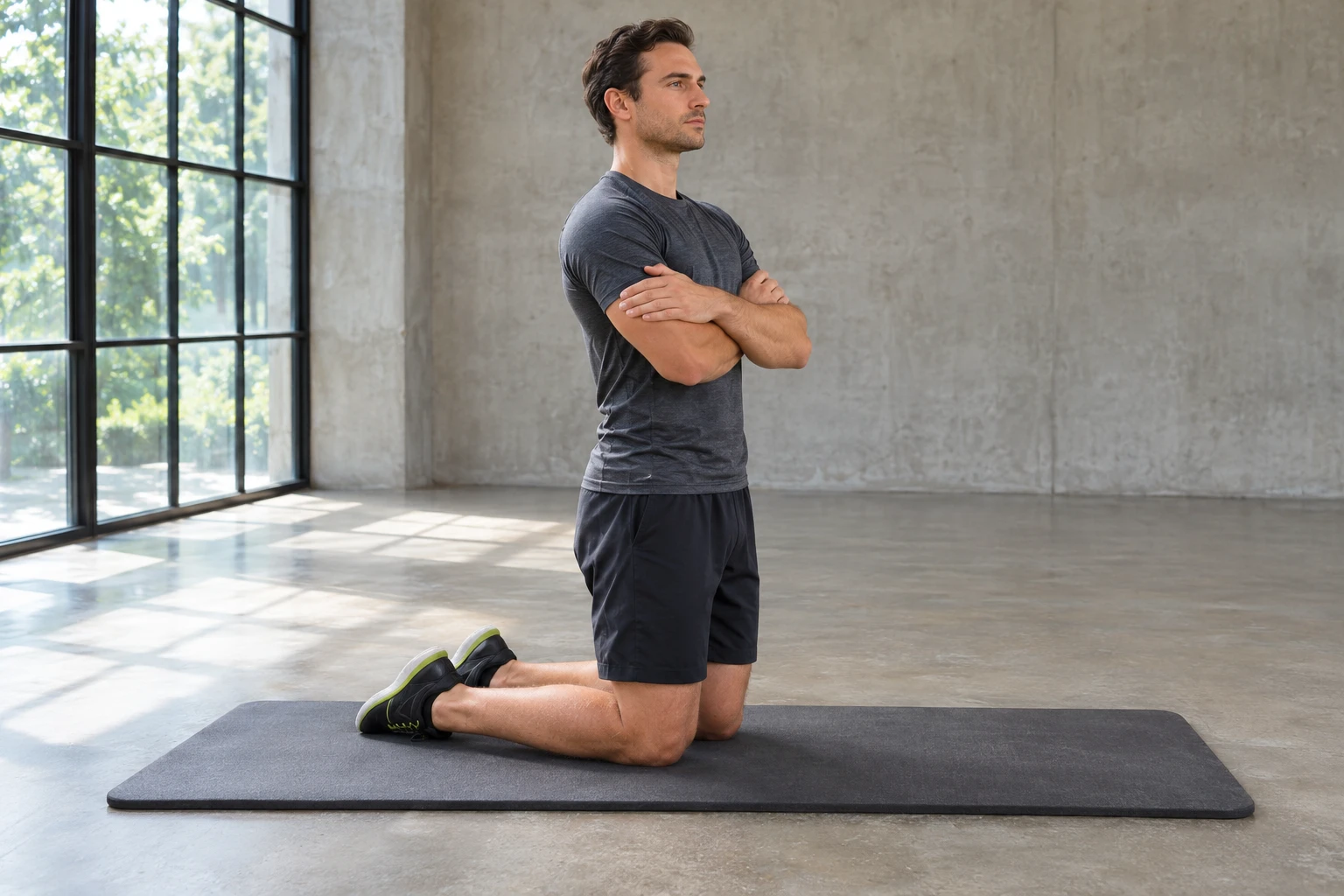
- Kneel on a padded exercise mat with your knees approximately hip-width apart.
- Rest the tops of your feet on the mat, allowing your ankles to settle into a comfortable position.
- Stand tall through your thighs, with hips above knees and shoulders above hips.
- Lightly squeeze your glutes, brace your abdomen and cross your arms over your chest.
Execution
- Begin leaning backwards by bending at the knees, moving your thighs and trunk together.
- Lower slowly while maintaining a straight line from your knees through your hips to your shoulders.
- Stop before your hips fold, your lower back arches or you lose control.
- Use your quadriceps to bring your whole body back to tall kneeling without bouncing.
- Reset your alignment and breathing before the next repetition.
Coaching cues
- Move like one straight lever from knees to shoulders.
- Keep your hips open rather than sitting towards your heels.
- Bring your ribs with you; do not leave them flared behind your hips.
- Earn more depth through control, not momentum.
Common faults & fixes
- Sitting back at the hips: shorten the lean and gently squeeze your glutes to maintain hip extension.
- Arching the lower back: bring your ribs down, brace and reduce the range.
- Dropping quickly into the bottom: use a slower descent and stop earlier.
- Jerking forwards to return: reduce depth or add band assistance so the return stays smooth.
Regressions
- Use a shallow lean that you can reverse comfortably while keeping your body aligned.
- Hold a resistance band securely anchored in front of you, using its tension to assist the return; check the anchor before every set.
- Reach your arms forwards rather than crossing them over your chest to make the lean slightly easier.
Variations
- Tempo reverse Nordic: take three to four seconds to lower while keeping the return controlled.
- Paused reverse Nordic: hold briefly at your deepest controlled position before returning upright.
- Arms-overhead reverse Nordic: extend your arms overhead to increase the lever challenge, initially reducing depth.
Programming ideas
- Introduction: perform 2 sets of 4–6 shallow repetitions after your main strength work, resting 60–90 seconds.
- Strength accessory: build towards 2–3 sets of 6–10 controlled repetitions, stopping before alignment deteriorates.
- Progression: increase comfortable range before adding longer pauses or a more demanding arm position; change one variable at a time.
Safety
Use sufficient knee padding and never force yourself towards the floor. Stop the set for sharp or increasing knee pain, ankle pain, lower-back discomfort or loss of control. Quadriceps effort and a stretching sensation are expected, but joint pain is not a target. If kneeling is uncomfortable despite padding, choose another quadriceps exercise. Existing knee conditions, recent surgery or persistent symptoms need clinician review before using this movement.
In depth
Why use the reverse Nordic curl?
This movement trains the quadriceps as you control knee flexion and then extend the knees to return upright. Keeping the hips extended distinguishes it from sitting back onto your heels. It offers a compact accessory option when you want additional thigh work without holding a barbell or dumbbells.
When should hybrid athletes include it?
Place it after your main lower-body lifts, rather than treating it as a conditioning station. Running, lunges and sled work already place demands on the legs, so introduce this exercise gradually. Prioritise repeatable technique and assess how your legs recover before increasing the range or number of sets.
Keep training
Related exercises

Tempo Back Squat
Shared: Core, Glutes, Quadriceps, Controlled Eccentric

Air Squat
Shared: Quadriceps, Glutes, Core, Bodyweight

Nordic Hamstring Curl
Shared: Glutes, Core, Exercise Mat, Bodyweight, Controlled Eccentric

Box Squat (Various Heights)
Shared: Core, Glutes, Quadriceps

Bird Dog Hold
Shared: Core, Glutes, Bodyweight, Exercise Mat

Hamstring Walkout
Shared: Glutes, Core, Bodyweight, Exercise Mat