
Cable Woodchop
A standing high-to-low cable exercise that trains controlled rotation through a diagonal pulling action.

Setup
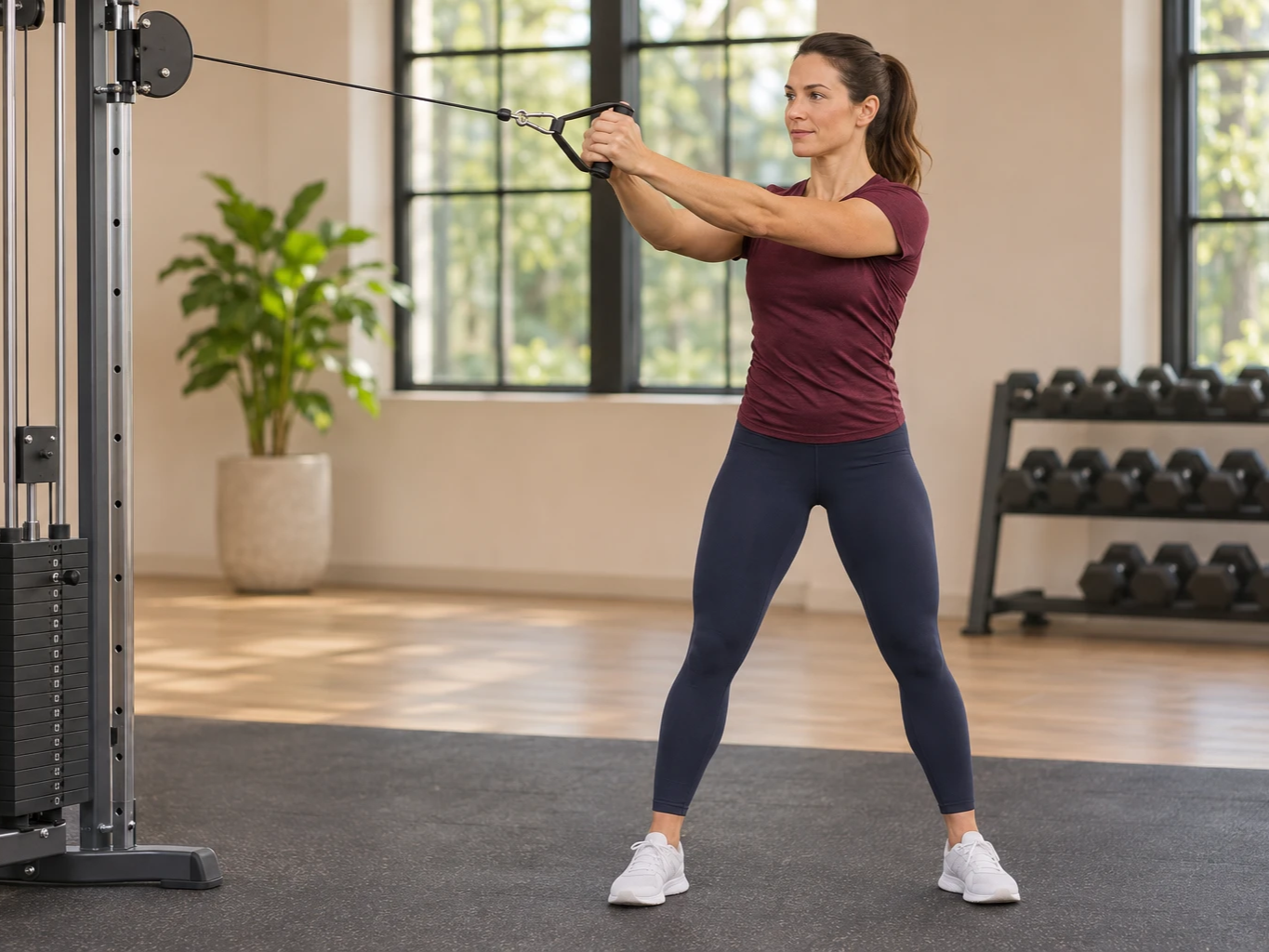
- Set an adjustable cable pulley above shoulder height and attach a handle that you can hold securely with both hands.
- Stand side-on to the machine with your feet about shoulder-width apart and your knees softly bent.
- Hold the handle with both hands near the shoulder closest to the pulley, keeping a slight bend in your elbows.
- Step far enough away to maintain cable tension, check that the cable path is clear and lightly brace your trunk.
Execution
- Begin with your chest and hips turned slightly towards the pulley, using only a comfortable range.
- Draw the handle diagonally across your body towards the outside of the opposite hip.
- Turn your chest and hips together, allowing your feet to pivot rather than forcing rotation through your lower back.
- Finish balanced, with your hands near the opposite hip and your ribs stacked over your pelvis.
- Reverse the movement slowly, resisting the cable as you return. Complete your repetitions, then change sides.
Coaching cues
- Turn together: chest, hips and feet.
- Keep your elbows softly bent rather than rowing the handle.
- Finish tall; do not fold sideways towards your hip.
- Control the return as carefully as the pull.
Common faults & fixes
- Feet stay planted while the torso twists sharply: reduce the range and allow a natural foot pivot so your hips can follow.
- Arms do most of the work: lighten the load and maintain a consistent elbow angle throughout the diagonal path.
- The body leans sideways at the finish: stop the handle closer to your hip and keep your ribs over your pelvis.
- The cable pulls you back or the stack crashes: reduce the load and take two to three seconds to return.
Regressions
- Lower the cable resistance until every repetition feels balanced and the return stays smooth.
- Shorten the diagonal path, starting closer to chest height and finishing before you lose trunk control.
- Keep your hands slightly closer to your torso to shorten the lever, while preserving the same coordinated turn.
Variations
- Low-to-high cable lift: set the pulley low and move diagonally towards the opposite shoulder, using a lighter load initially.
- Paused cable woodchop: hold the finish briefly without leaning or allowing the cable to pull you out of position.
- Slow-return cable woodchop: take three seconds to reverse each repetition, keeping the outward movement smooth rather than explosive.
Programming ideas
- Strength accessory: perform 2–3 sets of 8–12 controlled repetitions per side after your main strength exercises.
- Movement preparation: use 1–2 light sets of 6–8 repetitions per side to practise coordinated rotation without creating fatigue.
- Hybrid accessory circuit: pair 8–10 repetitions per side with a carry and an easy aerobic interval. Keep the woodchop controlled rather than racing the clock.
Safety
Check the pulley adjustment, attachment and weight-stack pin before starting. Keep people clear of the cable path and avoid jerking the handle. Stop the set if you develop sharp pain, feel dizzy, lose your grip or cannot control your balance or the return. Do not force a larger rotational range. If a medical condition or recent injury affects your back, hips or shoulders, seek clinician review before using this exercise.
In depth
Why include the cable woodchop?
The cable woodchop trains you to produce and control rotation against resistance. Unlike a Pallof press, which challenges you to resist turning, this version deliberately coordinates the chest, hips and feet through a diagonal movement. The aim is smooth force transfer, not the biggest possible twist or the heaviest stack.
When should hybrid athletes use it?
Use it as supplementary trunk work after your main lifts or within a controlled accessory circuit. It adds a rotational task to programmes dominated by forward running, squatting and carrying. Keep it separate from all-out conditioning when fatigue makes the movement jerky, and prioritise event-specific practice when training time is limited.
+Should your hips move during a cable woodchop?
+How heavy should a cable woodchop be?
+Is the cable woodchop useful for HYROX training?
Keep training
Related exercises
Landmine Anti-Rotation Press (Pallof Press Variation)
Shared: Abs, Obliques, Shoulders

Landmine Reverse Lunge to Press
Shared: Abs, Obliques, Shoulders

Kettlebell Windmill
Shared: Obliques, Shoulders, Rotation

Landmine Rotational Clean
Shared: Obliques, Shoulders, Rotation

Landmine Rotational Clean & Press
Shared: Obliques, Shoulders, Rotation

Landmine Rotational Press
Shared: Obliques, Shoulders, Rotation