
Barbell Rollout
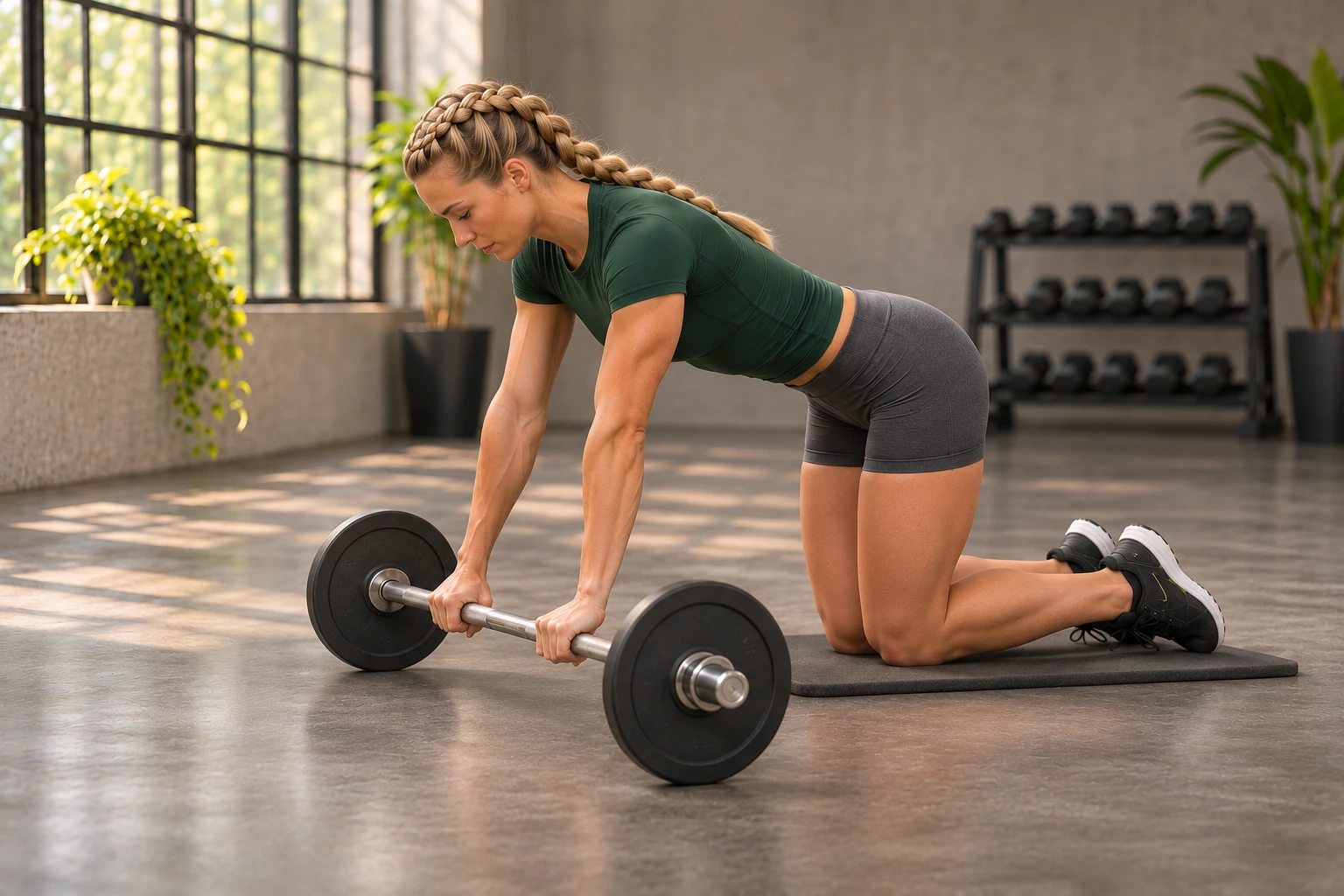
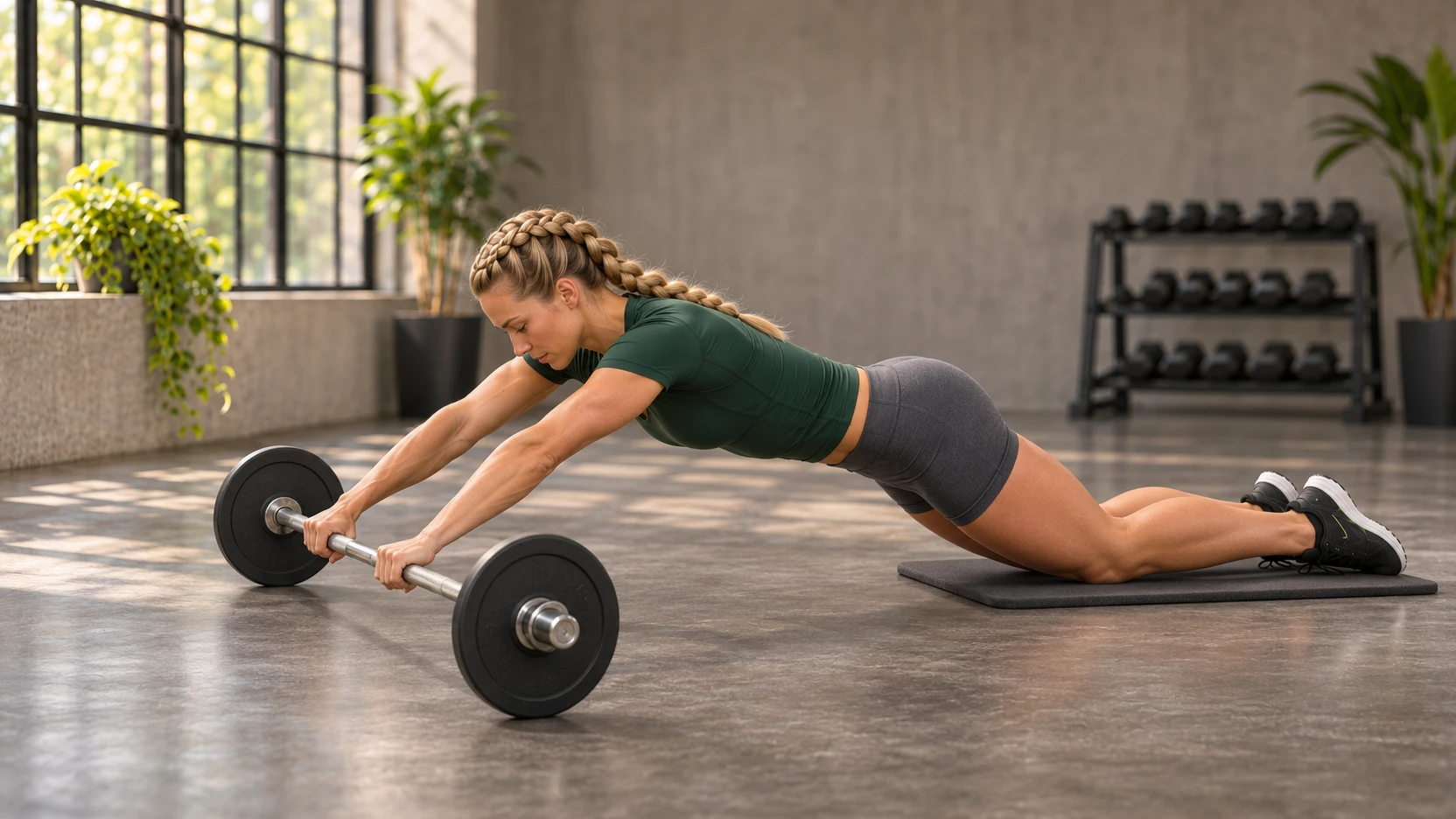
A kneeling barbell exercise that challenges your abdominals to resist lower-back extension as your arms reach forwards.

Setup
- Fit a barbell with matching round plates and secure them with collars. Check that both ends roll smoothly without wobbling.
- Choose a clear, level surface with enough space ahead of you. Avoid slopes or surfaces where the plates skid.
- Kneel on an exercise mat with the bar close to your knees, then take an overhand grip just outside shoulder width.
- Start with your shoulders approximately over the bar, elbows straight but not forced, and ribs stacked over your pelvis.
Execution
- Brace your abdominals and lightly squeeze your glutes before moving the bar.
- Roll the bar forwards slowly, allowing your shoulders and hips to travel forwards together as your body lengthens.
- Stop at the furthest position you can hold without letting your lower back sag or shoulders become uncomfortable.
- Pull the bar back towards your knees while maintaining your brace; avoid sending your hips backwards ahead of your shoulders.
- Reset your starting position and breathing before the next repetition.
Coaching cues
- Keep your ribs down as your hands travel forwards.
- Reach long without dropping your stomach towards the floor.
- Move your hips and shoulders together on the return.
- Finish the repetition before your brace fails.
Common faults & fixes
- Lower back arching: shorten the rollout and reset your rib-to-pelvis position before trying again.
- Hips shooting backwards first: reduce the range and initiate the return by pulling the bar towards you while keeping your trunk firm.
- Elbows bending into a rowing action: maintain a consistent arm position and use a shorter reach.
- Bar drifting sideways: check plate size, collars and floor level, then apply even pressure through both hands.
Regressions
- Practise a kneeling plank with your hands on the bar, keeping it stationary beneath your shoulders.
- Use short-range kneeling rollouts, moving only a small distance beyond the starting position.
- Perform fewer repetitions per set with a full reset between repetitions, stopping before trunk control deteriorates.
Variations
- Paused rollout: briefly hold your controlled end position before returning.
- Tempo rollout: take three seconds to roll forwards while maintaining the same manageable range.
- Standing barbell rollout: an advanced progression from the feet, reserved for athletes with strong, repeatable kneeling technique; begin with a limited range.
Programming ideas
- Start with 2–3 sets of 4–6 short-range repetitions after your main strength work, resting 60–90 seconds between sets.
- For controlled accessory work, build towards 3 sets of 6–10 repetitions without extending beyond your stable range.
- Progress reach gradually before adding repetitions or pauses. Change one variable at a time and finish each set with technically sound repetitions still available.
Safety
Stop the set if your lower back repeatedly sags, the bar accelerates beyond your control or the plates skid or wobble. Stop the exercise for sharp pain, pinching, numbness or discomfort in your back, shoulders, wrists or knees. Do not force overhead shoulder range or use heavier plates as an automatic progression: leverage and reach strongly affect difficulty. Existing injuries or medical conditions require individual clinician review; this guidance is educational, not rehabilitation advice.
In depth
Why use this movement for hybrid training?
The rollout increases the distance between your knees and hands while your trunk resists extension. This makes a relatively small movement demanding without requiring a heavily loaded bar. For hybrid athletes, it offers focused practice in maintaining trunk position as the arms move away from the body, complementing loaded carries, overhead work and station-specific training.

When should you programme a barbell rollout?
Place it after your main lifts rather than before heavy work that needs a fresh brace. Keep it out of rushed conditioning circuits while learning: fatigue can turn a controlled reach into an uncontrolled drop. Treat range as something you earn through repeatable technique, not a target to force on every repetition.
+How far should you roll the barbell forwards?
+Is the barbell rollout suitable for beginners?
+Where does it fit in HYROX training?
Keep training
Related exercises

Dead Bug
Shared: Abs, Obliques, Exercise Mat, anti-extension, Core Stability

Landmine Reverse Lunge to Press
Shared: Abs, Obliques, Shoulders, Barbell, Weight Plates
Landmine Anti-Rotation Press (Pallof Press Variation)
Shared: Abs, Obliques, Shoulders, Barbell

Cable Woodchop
Shared: Obliques, Abs, Shoulders

Lateral Med Ball Slam
Shared: Lats, Obliques, Shoulders

Med Ball Rotational Throw to Wall
Shared: Lats, Obliques, Shoulders