
TRX Hamstring Curl
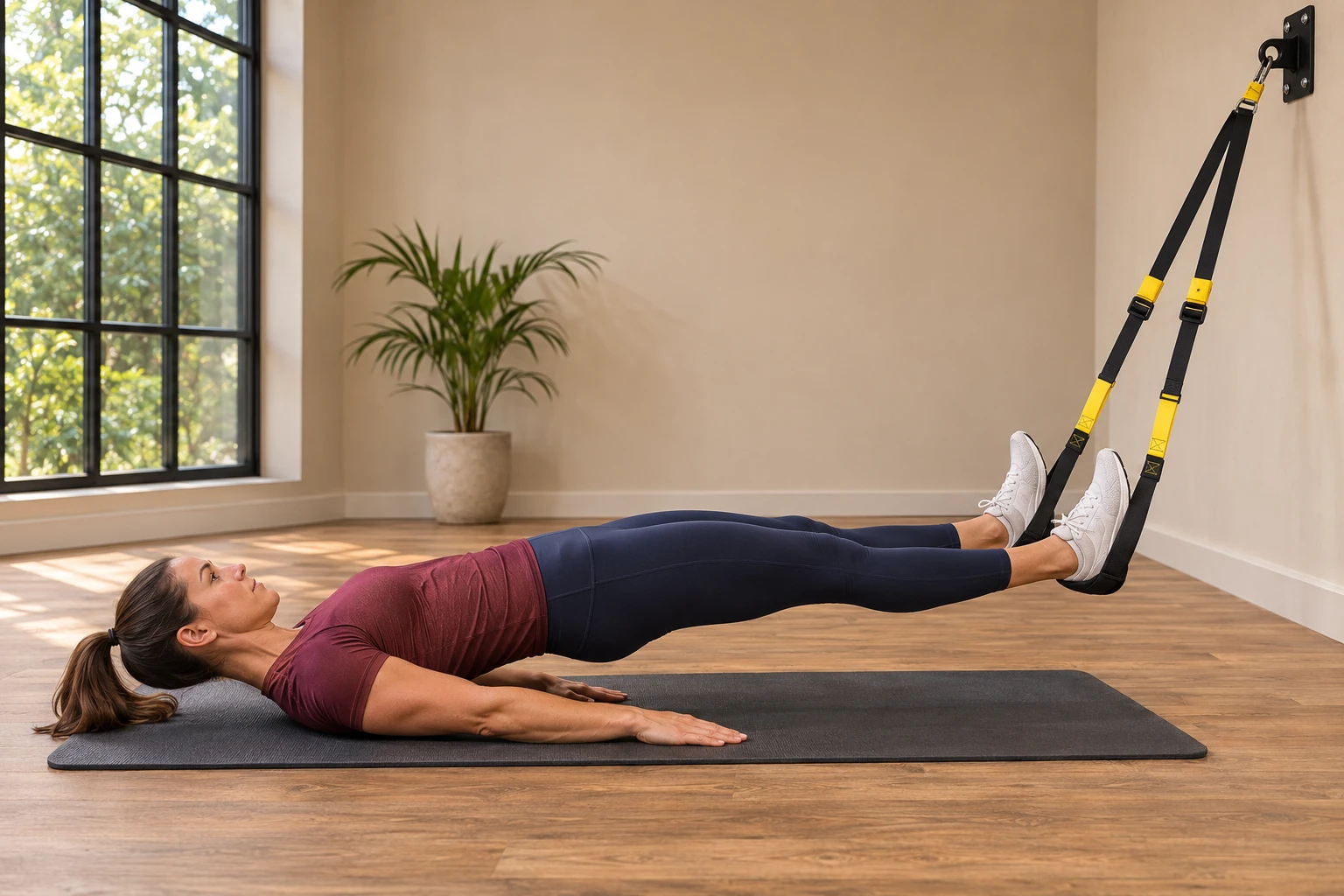
A suspended heel curl that trains knee flexion while your glutes and trunk help maintain an elevated, controlled hip position.

Setup
- Attach the suspension trainer to a secure, manufacturer-approved anchor and check the straps and foot cradles.
- Set both cradles to equal height, low enough to allow your heels to hang just above the floor when you lie down.
- Lie on your back on a mat with your heels securely supported in the cradles and your legs almost straight.
- Place your arms beside you, palms down, and position yourself so the straps remain taut without rubbing against your legs.
Execution
- Brace your trunk gently and press your heels down into the cradles.
- Squeeze your glutes to lift your hips clear of the mat without arching your lower back.
- Bend both knees to draw your heels towards your backside, keeping your pelvis level.
- Pause briefly at the furthest position you can reach without losing hip control.
- Slowly extend your knees, stopping before your hips sag or your lower back arches. Finish the set by lowering your hips to the mat.
Coaching cues
- Press your heels down, then pull them in.
- Keep your ribs settled rather than lifting your chest.
- Move both heels together and keep your pelvis level.
- Make the return as controlled as the curl.
Common faults & fixes
- Hips sag as the legs straighten: stop the return earlier and rebuild the range gradually.
- Lower back arches to create extra height: reduce the hip lift and keep your ribs aligned over your pelvis.
- Straps swing or repetitions become jerky: slow down and pause briefly between repetitions.
- One heel moves ahead of the other: check equal strap length and use a shorter range you can control symmetrically.
Regressions
- Keep your hips on the mat and practise bending and straightening your knees with your heels suspended.
- Use a partial-range elevated curl, stopping the extension before your hips begin to drop.
- Perform short sets of three to five controlled repetitions, resting fully before technique deteriorates.
Variations
- Eccentric-focused curl: draw the heels in, then take three to four seconds to extend your legs.
- Paused curl: hold the bent-knee position for two seconds while maintaining a level pelvis.
- Single-leg suspension curl: use one working heel and a reduced range initially; reserve this for athletes with strong bilateral control.
Programming ideas
- Technique practice: perform two sets of five to eight repetitions with a comfortable range and at least 60 seconds of rest.
- Strength accessory: perform two to three sets of eight to twelve controlled repetitions, resting 60–90 seconds and leaving roughly two repetitions in reserve.
- Hybrid scheduling: place it after your main strength work rather than in a rushed conditioning circuit; increase repetitions or range before choosing a harder variation.
Safety
Check the anchor, straps and cradles before every session and keep the surrounding floor clear. Support your upper body through your shoulders and arms rather than pushing through your neck. End the set if your hips repeatedly sag, the straps slip or you cannot control the return. Stop for sharp pain or hamstring cramping and lower your hips safely. Existing hamstring, knee or back conditions require clinician review before using this exercise as rehabilitation; this guidance is educational, not a treatment plan.
In depth
Why use the TRX hamstring curl?
This exercise adds direct knee-flexion work to a programme that may already include squats, lunges and deadlifts. Your hamstrings draw your heels towards you while your glutes and trunk help support your hips. Unlike a Nordic curl, your feet move and your upper body stays supported on the floor.
When does it fit into hybrid training?
Use it as controlled accessory work after your main strength exercises. It offers a practical hamstring-training option when a leg-curl machine is unavailable, although it is not a HYROX race movement. Start with modest volume, keep repetitions smooth and account for any lingering fatigue when planning your next demanding run.
+How is this different from a Nordic hamstring curl?
+Should my hips stay lifted throughout the repetition?
+Where should hybrid athletes place this exercise in a session?
Keep training
Related exercises

Barbell Clean
Shared: Core, Glutes, Hamstrings, Pull

Barbell Overhead Squat
Shared: Core, Glutes, Hamstrings, Stability

Barbell Power Clean
Shared: Core, Glutes, Hamstrings, Pull

Barbell Reverse Lunge
Shared: Core, Glutes, Hamstrings, Stability

Barbell Split Squat
Shared: Core, Glutes, Hamstrings, Stability

Barbell Zercher Lunge
Shared: Core, Glutes, Hamstrings, Stability