
Side Plank
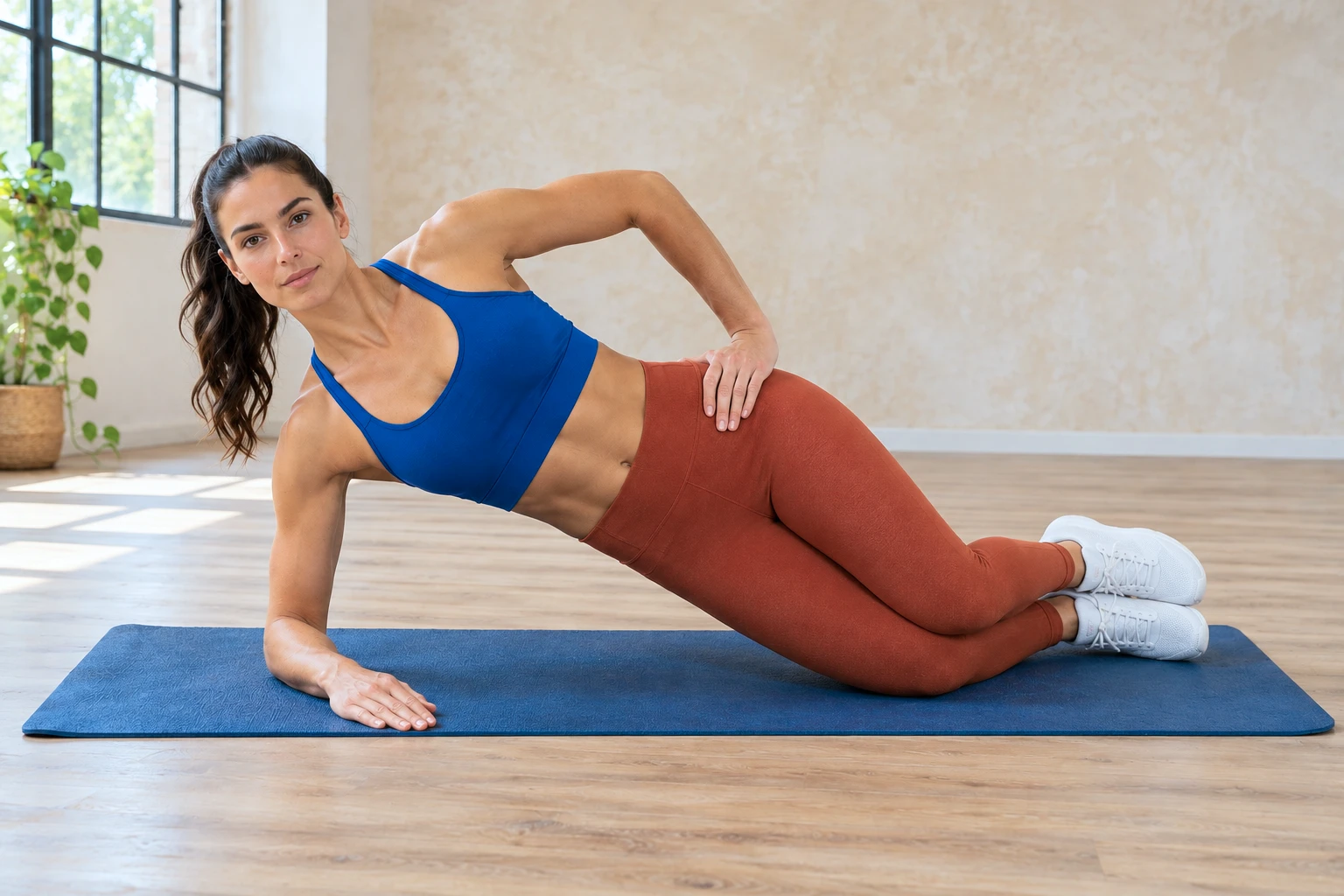
A forearm-supported isometric hold that develops lateral trunk control and challenges shoulder and hip stability.

Setup
- Lie on one side on a firm, comfortable surface with your legs straight.
- Place your supporting elbow directly beneath your shoulder, with your forearm resting on the floor.
- Stack your feet and align your shoulders, hips and ankles.
- Rest your top hand on your hip and gently brace your trunk before lifting.
Execution
- Press your forearm and the outer edge of your bottom foot into the floor to lift your hips.
- Form a straight line from your head through your hips to your ankles, keeping your head in line with your spine.
- Keep your chest facing forwards and your pelvis stacked rather than rolling towards the floor.
- Breathe steadily throughout the hold, then lower your hips under control and repeat on the other side.
Coaching cues
- Push the floor away through your forearm.
- Keep your ribs and pelvis aligned.
- Lift the underside of your waist away from the floor.
- Keep breathing; do not turn the hold into a breath-holding contest.
Common faults & fixes
- Hips sagging: shorten the hold or switch to bent-knee support before alignment deteriorates.
- Torso rolling forwards: stack the top shoulder above the bottom shoulder and keep your top hand on your hip for feedback.
- Collapsing into the supporting shoulder: reposition your elbow beneath the shoulder and actively press your forearm down.
- Neck tilting or jaw tightening: look straight ahead, relax your face and keep your head aligned with your torso.
Regressions
- Bent-knee side plank: bend both knees and support yourself through your forearm and bottom knee, maintaining a straight shoulder-to-knee line.
- Staggered-foot side plank: place the top foot slightly ahead of the bottom foot so both feet provide support.
- Short repeated holds: practise 5–10-second holds with a complete reset between efforts instead of one continuous hold.
Variations
- Side plank with top-leg lift: raise the upper leg slightly without rotating your pelvis; use only after mastering the standard hold.
- Side plank reach-through: move the top arm beneath your torso and return under control, adding deliberate rotation.
- Side plank hip lift: lower your hips a small distance towards the floor, then return to the straight-line position without bouncing.
Programming ideas
- Strength accessory: complete 2–3 sets of 15–30 seconds per side after your main lifts, resting enough to reproduce good alignment.
- Warm-up practice: use 1–2 easy sets of 10–15 seconds per side before running or carries, avoiding fatigue.
- Progression: start with the less controlled side and match its clean hold time on the other side. Add five seconds at a time before increasing difficulty.
Safety
Use a non-slip surface and stop the set when you can no longer maintain hip height, shoulder support or steady breathing. Stop immediately for sharp pain, tingling, numbness or shoulder instability. Do not force the full version through symptoms. Existing shoulder, spinal or hip conditions require individual guidance from a qualified clinician; these instructions are educational, not medical advice.
In depth
Why use the side plank in hybrid training?
Running and loaded carries require you to control your trunk while forces act unevenly across your body. The side plank provides a simple way to practise resisting sideways bending without adding more loaded leg work. It complements front planks and dynamic strength exercises rather than replacing them.
When should you programme it?
Place challenging holds after strength work or in a short accessory session. Before running or HYROX practice, keep holds brief and comfortable so your trunk and supporting shoulder are not fatigued. Judge each set by alignment and breathing, not just the stopwatch: a shorter, controlled hold is more useful than extending a set with sagging hips.
+How long should you hold a side plank?
+How is a side plank different from a front plank?
+Should you feel a side plank in your shoulder?
Keep training
Related exercises

Copenhagen Plank
Shared: Obliques, Hip Stabilizers, Exercise Mat, Isometric Hold

Bird Dog Hold
Shared: Shoulders, Bodyweight, Exercise Mat, Isometric Hold

Single-Leg Lateral Skater Hop to Stick
Shared: Hip Stabilizers, Obliques, Bodyweight

Kettlebell Single-Leg Romanian Deadlift
Shared: Hip Stabilizers, Obliques

Kettlebell Windmill
Shared: Obliques, Shoulders
Landmine Anti-Rotation Press (Pallof Press Variation)
Shared: Obliques, Shoulders