
Dumbbell Devil's Press
Combine a dumbbell burpee with a hip-driven lift to overhead for full-body conditioning and repeated floor-to-standing transitions.

Setup
- Use two stable, preferably hexagonal dumbbells on a firm, non-slip surface. Avoid round dumbbells that can roll under your hands.
- Place the dumbbells approximately shoulder-width apart, leaving enough room to lower your chest between them.
- Check that you have clear space behind you, around your feet and overhead.
- Start with a light load and rehearse the hinge and overhead finish before adding the burpee.
Execution
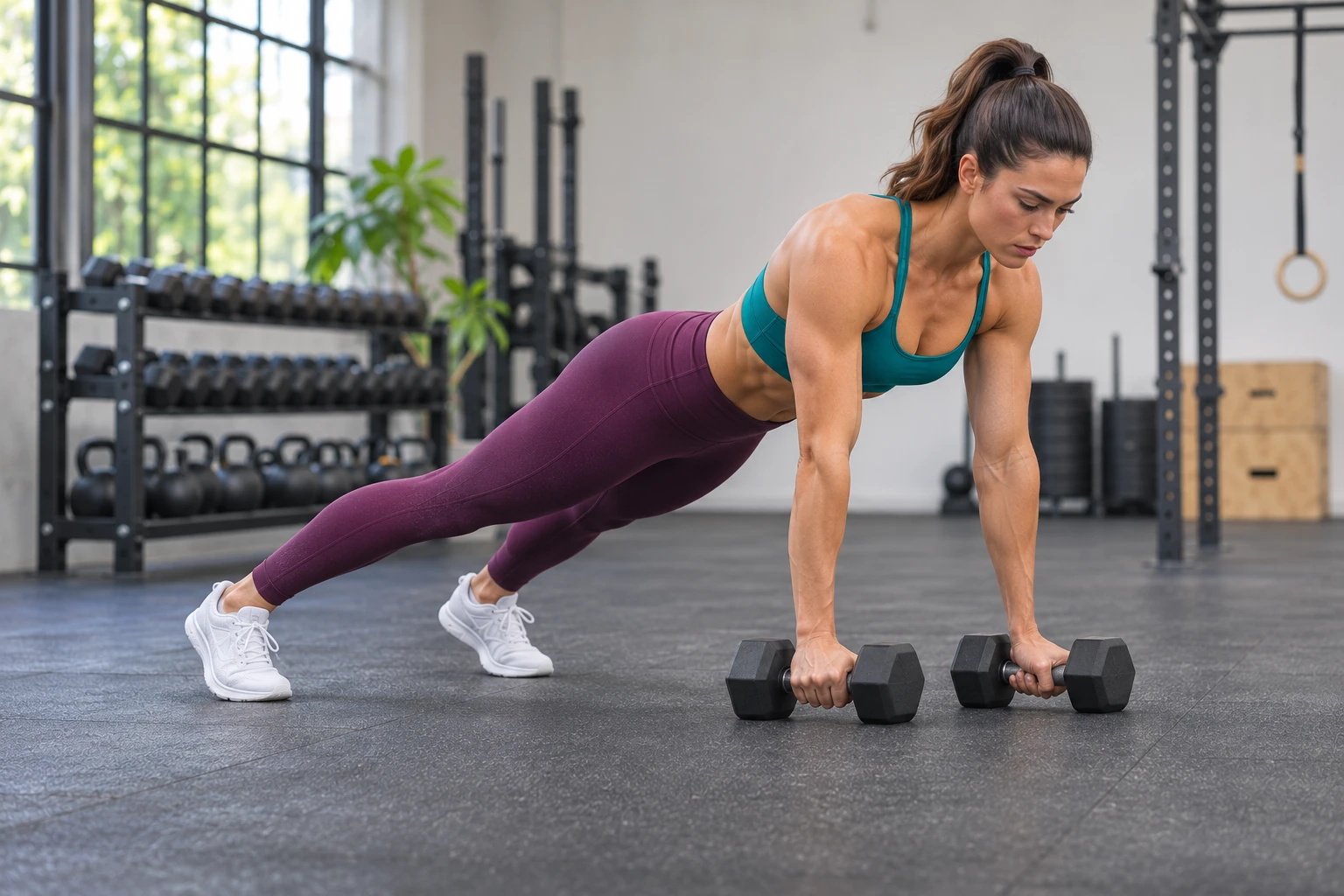
- Hinge and bend your knees to grip the dumbbells, then step or jump your feet back into a supported plank.
- Bend your elbows and lower your chest towards the floor between the dumbbells, keeping the descent controlled.
- Push back up and step or jump your feet forward outside the dumbbells. Establish a balanced stance before lifting.
- With a braced trunk and long arms, lift the dumbbells from the floor and guide them back between your thighs as you hinge.
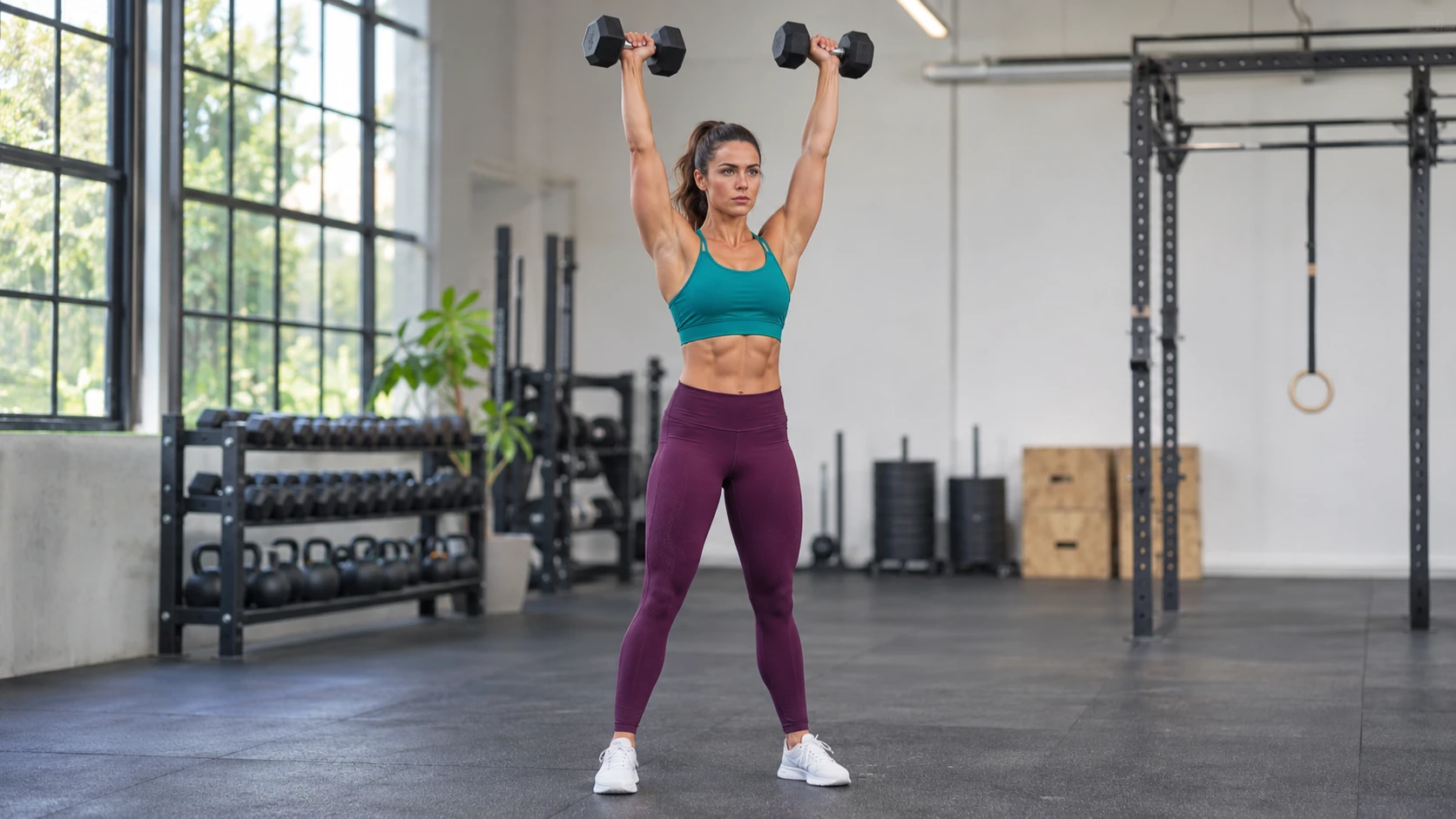
- Drive through your feet and extend your hips, guiding both dumbbells forwards and upwards into a stable overhead position without pausing at your shoulders.
- Finish tall with straight elbows and ribs stacked over your pelvis. Lower the weights under control to your shoulders, then your sides, before hinging and bending your knees to place them on the floor.
Coaching cues
- Own the plank before you lower your chest.
- Bring your feet forward, then find your balance.
- Hips back on the backswing; drive through the floor.
- Let your hips create momentum rather than pulling early with your arms.
- Finish tall, not leaning backwards.
Common faults & fixes
- Dumbbells wobble during the burpee: use stable hexagonal weights and reset their position before each repetition.
- Lower back rounds when the feet come forward: step in, widen your foot position enough to create space, and reset your hinge before lifting.
- The lift becomes a slow, grinding press: reduce the load and practise the hip-driven overhead phase separately.
- Ribs flare at lockout: use lighter dumbbells and finish with your trunk stacked rather than forcing the weights behind you.
- Weights crash onto the floor: lower through the shoulders and sides, then deliberately place them down.
Regressions
- Use a step-back and step-in burpee instead of jumping your feet.
- Use lighter dumbbells and pause after returning to your feet to organise the hinge.
- Practise the dumbbell burpee and hip-driven overhead lift separately before linking them.
Variations
- Single-dumbbell devil's press: use one weight and alternate working arms between repetitions.
- Dead-stop devil's press: reset the dumbbells and your breathing on the floor before every repetition.
- No-push-up devil's press: omit the chest-to-floor phase and move from a supported plank into the standing lift; identify this clearly as a modified version.
Programming ideas
- Technique practice: perform 3 sets of 3–5 light repetitions, resting 60–90 seconds and resetting between reps.
- Conditioning intervals: complete 4–6 rounds of 20 seconds of controlled work followed by 40 seconds of rest.
- Hybrid circuit: alternate 200 metres of easy-to-moderate running with 4–6 light repetitions for 3–4 rounds. Keep the pace repeatable rather than racing the opening round.
Safety
This movement requires a controlled push-up, hip hinge and pain-free overhead position. Stop the set if the dumbbells roll, your grip becomes insecure, your back position repeatedly changes or you cannot control the overhead finish and descent. Stop training for sharp pain, dizziness or unusual breathlessness. Do not force chest-to-floor depth or overhead range through discomfort. Existing wrist, shoulder or back conditions require individual clinician review before using this exercise.
In depth
Why use the dumbbell devil's press?
This established hybrid movement links a floor transition with a hip-driven overhead lift. It provides a compact conditioning option when you have dumbbells but no ergometer or sled. The challenge is coordinating the phases while maintaining control as breathing becomes harder—not simply moving the heaviest weights possible.
When should you programme it?
Use it in short conditioning intervals or mixed running sessions once the individual phases are reliable. For HYROX preparation, treat it as supplementary work rather than station practice. Keep early sessions light and avoid adding demanding sets when your shoulders, grip or lower back are already too fatigued to control the movement.
+Is the dumbbell devil's press a HYROX race movement?
+How heavy should the dumbbells be?
+Can you step your feet instead of jumping?
Keep training
Related exercises

Burpee Broad Jump
Shared: Chest, Glutes, Hamstrings, Shoulders, Hinge

Dumbbell Clean & Press
Shared: Glutes, Hamstrings, Shoulders, Dumbbells, Hinge

Dumbbell Deadlift to High Pull
Shared: Glutes, Hamstrings, Shoulders, Dumbbells, Hinge

Dumbbell Hang Clean & Press
Shared: Glutes, Hamstrings, Shoulders, Dumbbells, Hinge

Dumbbell Snatch
Shared: Glutes, Hamstrings, Shoulders, Dumbbells, Hinge

Barbell Clean
Shared: Glutes, Hamstrings, Shoulders, Hinge