
Turkish get-up
A controlled floor-to-standing kettlebell movement that challenges overhead stability, trunk control and whole-body coordination.

Setup
- Choose a clear, non-slip area with enough room to lie down, extend your arms and stand without overhead obstructions.
- Place a light kettlebell beside your right shoulder. Roll onto your right side and take the handle with both hands.
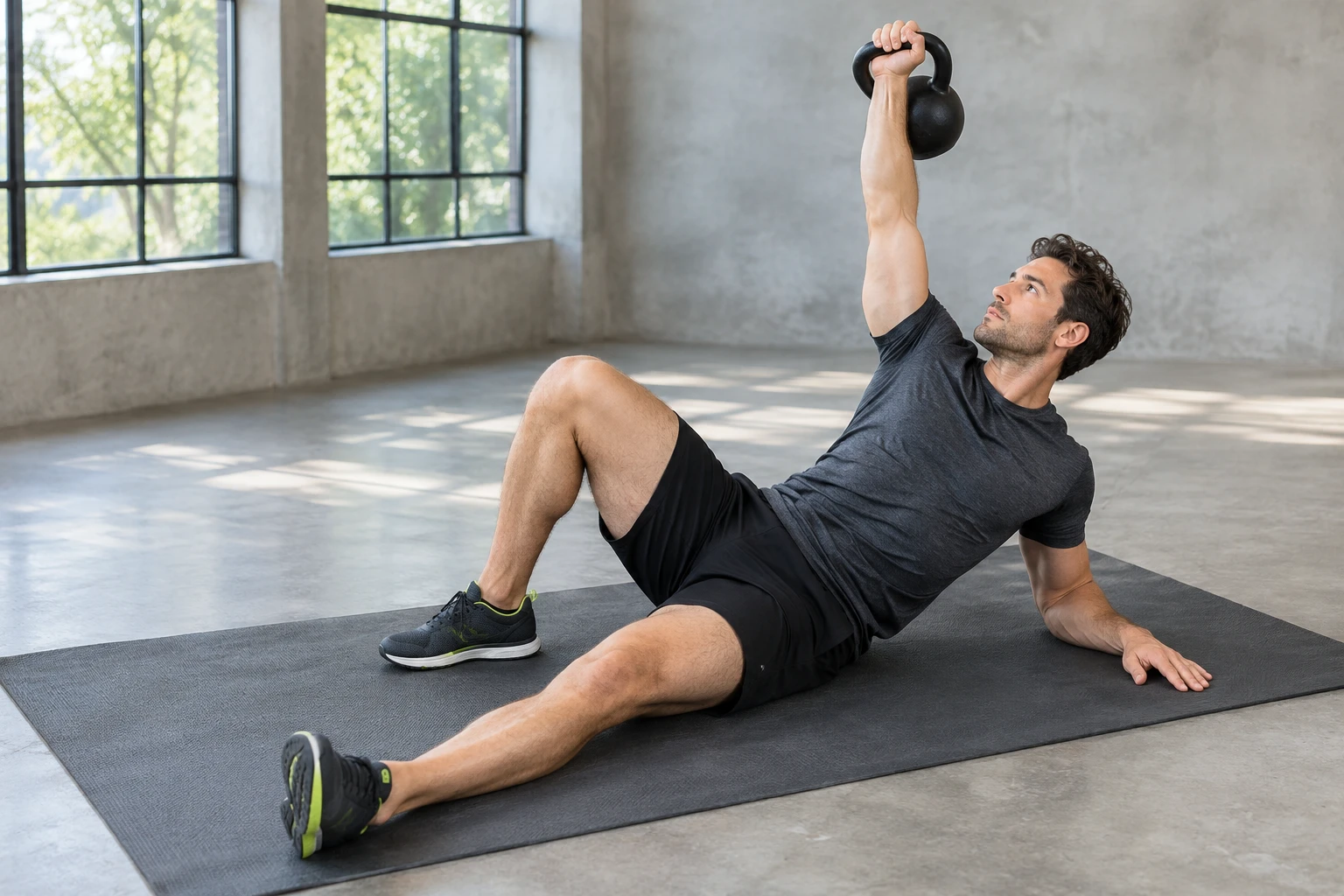
- Bring the bell close to your chest as you roll onto your back, then use both hands to assist it into a straight-arm position above your right shoulder.
- Bend your right knee and plant your right foot. Keep your left leg straight and slightly out to the side.
- Place your left arm roughly 45 degrees from your body, palm down. Keep your right wrist stacked over the forearm and watch the bell.
Execution
- Push through your right foot and roll diagonally onto your left forearm. Keep the bell above your shoulder rather than reaching it forwards.
- Press through your left hand to straighten the supporting arm and lift your torso into a tall seated position.
- Lift your hips enough to sweep your left leg underneath you. Place your left knee beneath your hip, keeping your left hand planted and the bell overhead.
- Shift your hips back towards your left heel, then bring your torso upright into half-kneeling. Reposition the left lower leg so both legs face forwards.
- Look forwards, drive through your right foot and stand tall. Keep your ribs controlled and your right arm vertical.
- Reverse the sequence: step the left leg back to kneel, reposition the lower leg and hinge sideways to plant your left hand. Lift your hips, sweep the left leg forwards, lower to sitting, then your left forearm and back. Use both hands to bring the bell to your chest and roll towards it to park it.
Coaching cues
- Move around the bell; do not chase it with your arm.
- Keep your wrist straight and your loaded elbow extended.
- Pause at each transition before moving the next limb.
- Watch the bell during floor transitions; look forwards once upright.
- Breathe steadily rather than holding your breath for the whole repetition.
Common faults & fixes
- The bell drifts away from the shoulder: reduce the load and pause with the wrist, elbow and shoulder vertically aligned.
- You attempt a straight sit-up: push through the planted foot and roll diagonally onto the opposite forearm.
- The sweeping leg catches underneath you: practise unloaded and lift the hips enough to create clearance before moving the knee.
- You wobble when standing or descending: reset the half-kneeling position, widen the base slightly and slow the transition.
Regressions
- Unloaded get-up: rehearse the full sequence with an empty fist pointing upwards.
- Get-up to elbow: practise only the roll from lying to the opposite forearm, then return slowly.
- Get-up to hand: progress from lying to the tall seated position without adding the leg sweep or standing phase.
Variations
- Paused Turkish get-up: hold each stable position briefly to check alignment and balance.
- Dumbbell Turkish get-up: use a light dumbbell while retaining the same sequence and straight wrist.
- Half Turkish get-up: finish in the tall seated position and reverse, using it as a shorter accessory exercise.
Programming ideas
- Technique practice: perform 2–3 unloaded or very light repetitions per side before strength work, resting between repetitions as needed.
- Strength accessory: complete 2–3 sets of 1–2 controlled repetitions per side with 60–90 seconds between sets, extending rest if control has not recovered.
- Hybrid training placement: use on a strength-focused day or before demanding conditioning, not as a race against the clock after exhaustive intervals.
Safety
Stop the repetition if the loaded elbow buckles, the bell drifts beyond control, your supporting hand slips or you cannot maintain balance. Stop the exercise for pain, numbness or dizziness. Use a lighter load or return to unloaded practice when technique deteriorates. Keep people and equipment clear of the working area; never try to catch a falling kettlebell. Existing shoulder, wrist, back or knee conditions require clinician review before loaded practice; this guidance is educational, not medical advice.
In depth
Why include the Turkish get-up?
This exercise combines an overhead hold with rolling, supporting, kneeling and standing. The challenge is maintaining control while your base of support changes. It offers hybrid athletes a deliberate strength accessory without adding another high-speed conditioning task.
When should you use it?
Practise while fresh enough to concentrate on the sequence. Begin unloaded, learn both sides and add weight gradually. Keep repetitions low and allow enough recovery to make the descent as controlled as the ascent. Progress through cleaner transitions before reaching for a heavier bell.
Keep training
Related exercises

Kettlebell Windmill
Shared: Core, Glutes, Shoulders, Triceps, Kettlebell, Overhead Stability

Kettlebell Clean & Jerk
Shared: Core, Glutes, Shoulders, Triceps, Kettlebell

Kettlebell Snatch
Shared: Core, Glutes, Shoulders, Triceps, Kettlebell

Barbell Clean & Jerk
Shared: Core, Glutes, Shoulders, Triceps

Barbell Overhead Carry
Shared: Core, Glutes, Shoulders, Triceps

Barbell Power Jerk
Shared: Core, Glutes, Shoulders, Triceps