
Cable Lat Pulldown: How Do You Build Pulling Strength?
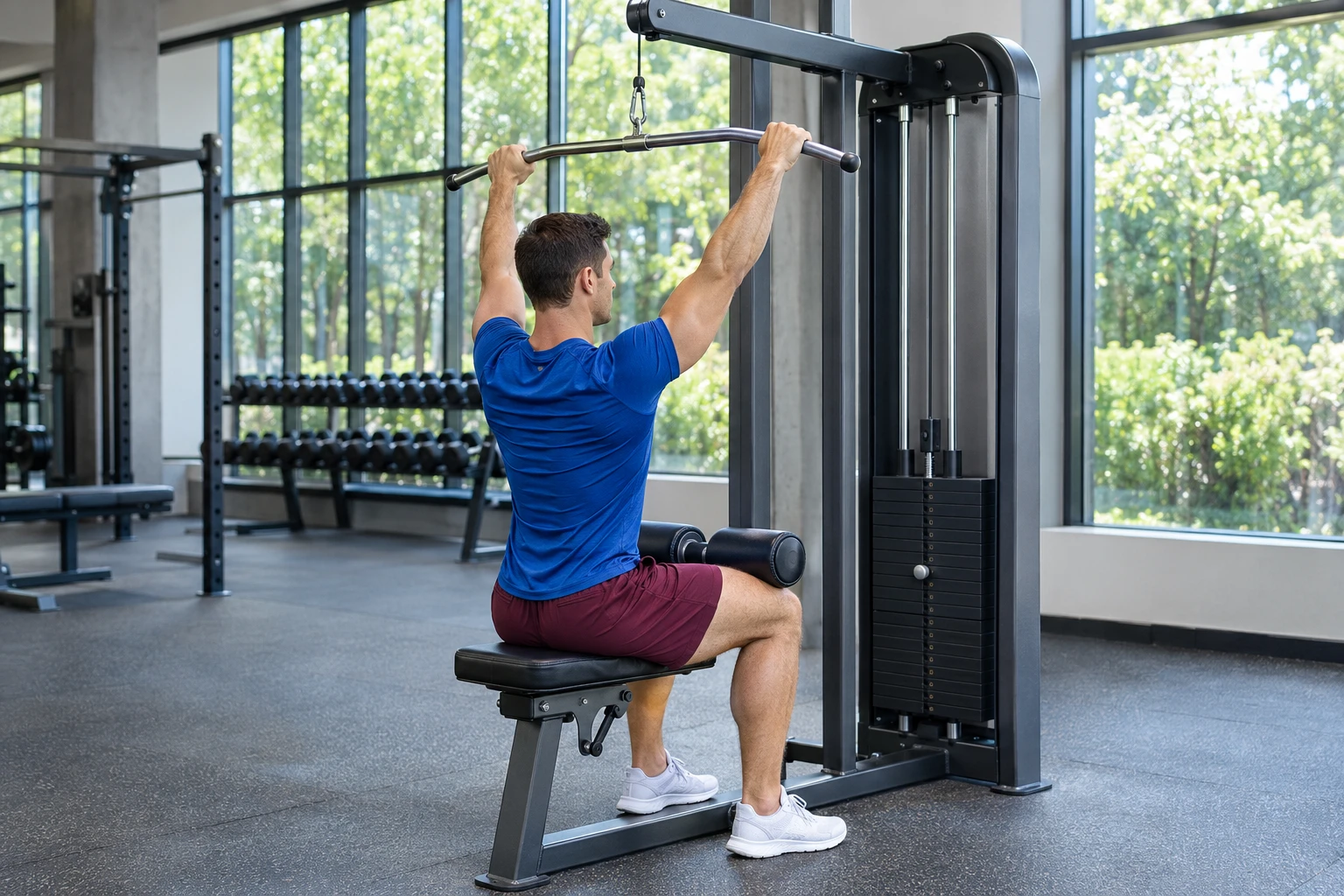
A seated cable exercise that develops the lats and elbow flexors through a controlled vertical pull with an adjustable load.

Setup
- Attach a lat pulldown bar securely to the high pulley of a seated pulldown station.
- Select a load you can move without swinging, then adjust the thigh pad so it holds your thighs firmly without discomfort.
- Take an overhand grip slightly wider than shoulder width, using the station's step if provided rather than jumping for the bar.
- Sit with both feet flat, arms reaching overhead and your torso tall with a small, fixed backward lean.
Execution
- Brace your trunk gently and keep your ribs stacked over your pelvis rather than lifting your chest into a large arch.
- Pull your elbows down towards your sides, bringing the bar towards your upper chest.
- Finish where your elbows are beside your torso and your shoulders remain controlled; do not drag the elbows far behind you.
- Pause briefly without bouncing the bar or changing your torso angle.
- Return the bar smoothly, allowing your elbows to straighten and shoulder blades to move upwards naturally without letting the weight stack crash.
Coaching cues
- Drive your elbows down, not your chest up.
- Keep the same small lean throughout the repetition.
- Keep your wrists close to straight and hold the bar securely.
- Reach long at the top without losing trunk control.
Common faults & fixes
- Rocking backwards to start each pull: reduce the load and keep your torso angle fixed.
- Pulling behind the neck: bring the bar in front of your face towards the upper chest instead.
- Shrugging or rolling the shoulders forwards at the bottom: stop the pull slightly earlier and use a lighter load.
- Keeping the shoulder blades pinned down throughout: allow them to move upwards during the controlled return.
- Letting the stack slam between repetitions: slow the return and finish the set when you can no longer control it.
Regressions
- Lower the stack weight until you can complete each repetition without swinging or lifting off the seat.
- Use a shorter, comfortable range temporarily if reaching or finishing the pull disrupts control; do not work through pain.
- Use shorter sets with full recovery if grip fatigue prevents a smooth pull and controlled return.
Variations
- Single-arm cable lat pulldown: use a single handle to train each side separately while resisting torso rotation.
- Paused cable lat pulldown: hold the bottom position briefly without leaning back further.
- Slow-return cable lat pulldown: take approximately three seconds to return overhead, reducing the load as needed.
Programming ideas
- For general strength assistance, perform 3 sets of 8–12 repetitions after your main lifts, finishing with around two controlled repetitions still available.
- For lighter pulling endurance work, perform 2–3 sets of 12–15 repetitions without allowing the final repetitions to become swinging pulls.
- For pull-up preparation, combine 2–3 pulldown sets with assisted pull-up practice elsewhere in your programme, adjusting total pulling volume to recovery.
Safety
Check the attachment, cable and weight pin before starting, and keep fingers clear of the stack. Never pull behind your neck or use bodyweight momentum to shift an excessive load. End the set if your thighs lift against the restraint, your torso starts swinging or you cannot control the return. Stop the exercise for sharp pain, numbness or tingling rather than forcing the range. Existing shoulder, elbow or neck conditions need individual clinician review; this guidance is educational, not treatment advice.
In depth
Why use the cable lat pulldown?
The cable lat pulldown offers a straightforward way to develop vertical pulling strength without needing to lift your full bodyweight. Its adjustable resistance makes it accessible to newer athletes and useful for experienced lifters who want additional pulling volume without adding more pull-up sets.
When should hybrid athletes programme it?
Place it after your main strength work, or on an upper-body accessory day. Keep demanding sets away from priority sled-pull or SkiErg sessions if fatigued lats and grip affect your technique. Treat it as supporting strength work: race-specific practice still develops the timing, positioning and sustained effort those stations require.
+Can cable lat pulldowns help you work towards a pull-up?
+Should the bar touch your chest?
+Where does this fit in HYROX training?
Keep training
Related exercises

Pull-Ups
Shared: Biceps, Lats, Upper Back, Pull, Vertical

Dumbbell Meadows Row
Shared: Biceps, Lats, Upper Back, Pull

Single-Arm Dumbbell Dead Stop Row
Shared: Biceps, Lats, Upper Back, Pull

Pull-Up Hold
Shared: Biceps, Lats, Pull, Vertical

Inverted Row
Shared: Biceps, Lats, Pull

Kettlebell Hang Clean
Shared: Lats, Upper Back, Pull