
Cable Face Pull
A controlled rope-cable pull towards the brow that targets the rear shoulders and upper back.

Setup
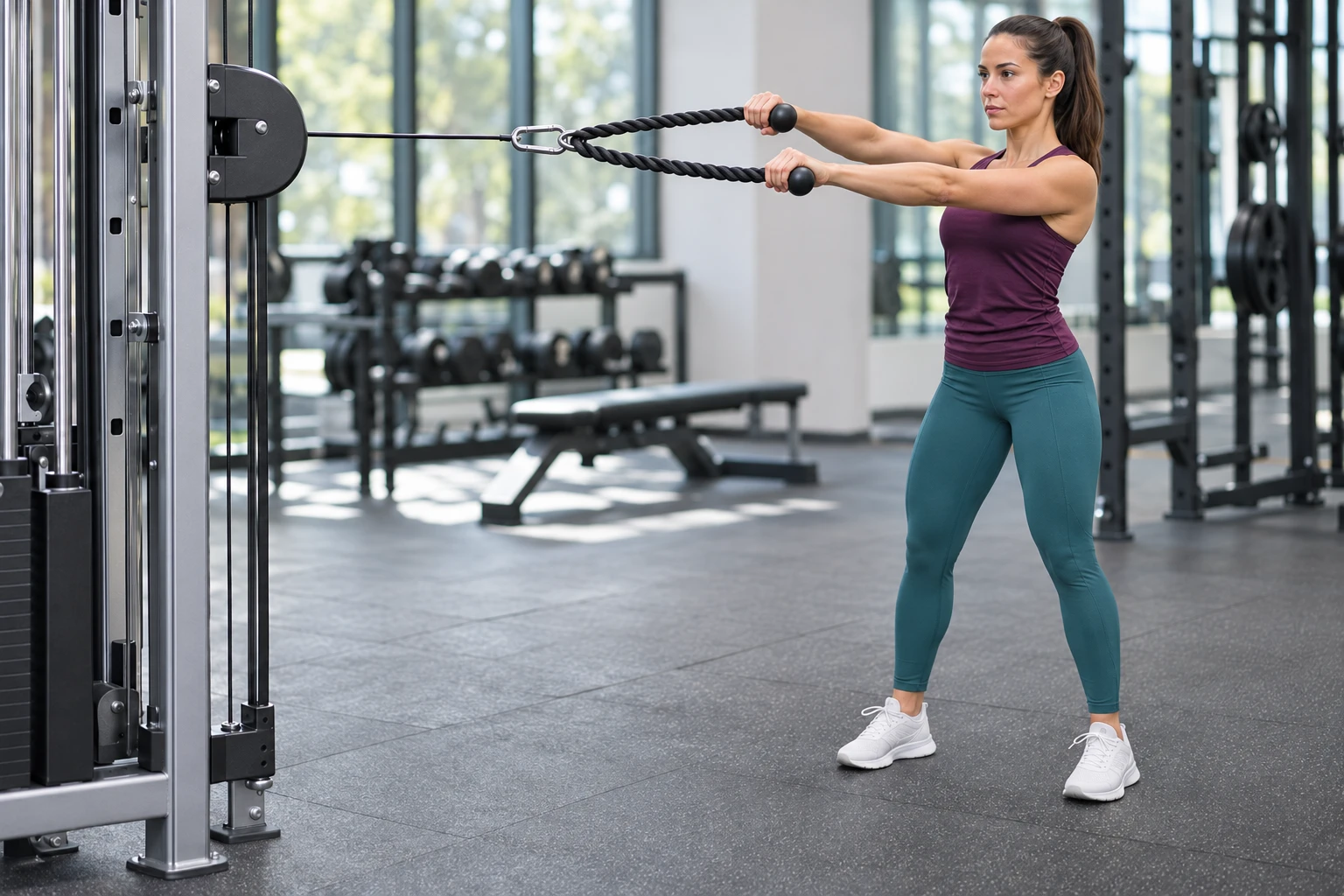
- Attach a rope handle securely to a cable pulley set around eye level.
- Hold one rope end in each hand and step back until your arms are extended and the cable is under light tension.
- Stand with soft knees and balanced foot pressure, keeping your ribs over your pelvis.
Execution
- Brace gently and begin pulling the rope towards your brow.
- Bend your elbows outwards while separating the rope ends.
- Finish with your hands beside your head and your upper arms around shoulder height or slightly below, according to comfort.
- Pause briefly without shrugging, pushing your head forwards or arching your lower back.
- Extend your arms under control, allowing your shoulder blades to move naturally around your ribcage.
Coaching cues
- Bring the rope to your face, not your face to the rope.
- Separate your hands as you pull.
- Keep your neck long rather than shrugging.
- Stay tall without leaning away from the stack.
- Make the return as deliberate as the pull.
Common faults & fixes
- Rocking backwards to complete the pull: reduce the load and keep your torso still throughout the repetition.
- Keeping the rope ends together: use lighter resistance and guide each hand towards the corresponding side of your head.
- Flaring the ribs at the finish: shorten the range slightly and maintain a gentle abdominal brace.
- Shrugging or forcing the elbows high: lower the elbow path slightly and use a comfortable range.
- Letting the weight stack crash: slow the return and stop the set when controlled repetitions are no longer possible.
Regressions
- Reduce the cable load until you can hold the finish briefly without moving your torso.
- Shorten the pulling range to the portion you can control comfortably, building range gradually rather than forcing the finish.
- Rehearse the hand and elbow path without resistance before returning to the lightest manageable cable setting.
Variations
- Seated cable face pull: use a stable bench and set the pulley around seated eye level to reduce help from the legs.
- Half-kneeling cable face pull: adjust the pulley to eye level and keep the pelvis and torso still.
- Paused cable face pull: hold the finish for two seconds while keeping the neck relaxed and the cable controlled.
Programming ideas
- Accessory strength: perform 2–3 sets of 10–15 controlled repetitions after your main upper-body lifts.
- Light preparation: use 1–2 easy sets of 12–15 repetitions before upper-body training, avoiding fatigue.
- Short supplementary session: pair 2–3 sets with a core exercise, resting enough to preserve technique.
- Progression: increase resistance by the smallest available increment only when every repetition remains controlled; leave a few repetitions in reserve.
Safety
Check the rope attachment and pulley pin before starting, and keep the cable path clear. Do not pull a damaged rope towards your face. Stop the set for sharp shoulder or neck pain, tingling, sudden weakness, or loss of control that brings the attachment towards your head. Reduce load or range for technique limitations, but do not train through symptoms. Existing shoulder or neck conditions require individual clinician review; this guidance is educational, not treatment advice.
In depth
Why use the cable face pull?
The cable face pull adds targeted rear-shoulder and upper-back work through a pulling action that combines outward elbow movement with shoulder rotation. It is an accessory lift, not a maximal-strength test: the useful challenge is controlling the movement without borrowing momentum from your trunk.
When should hybrid athletes programme it?
Place it after your main strength work when you want additional upper-body pulling without substantial leg loading. It also suits short supplementary sessions between harder running or station workouts. Keep race-specific training as the priority and use face pulls to fill an accessory role rather than adding unnecessary fatigue.
+How heavy should a cable face pull be?
+Where should the rope finish?
+Where does it fit in HYROX training?
Keep training
Related exercises

Barbell Bent-Over Row
Shared: Rear Delts, Rhomboids, Traps, Pull

Dumbbell Bent-Over Reverse Fly
Shared: Rear Delts, Rhomboids, Traps, Pull

Dumbbell Seal Row
Shared: Rear Delts, Rhomboids, Traps, Pull

Single-Arm Dumbbell Row to Rotation
Shared: Rear Delts, Rhomboids, Traps, Pull

Inverted Row
Shared: Rear Delts, Rhomboids, Pull

Barbell Clean
Shared: Traps, Pull