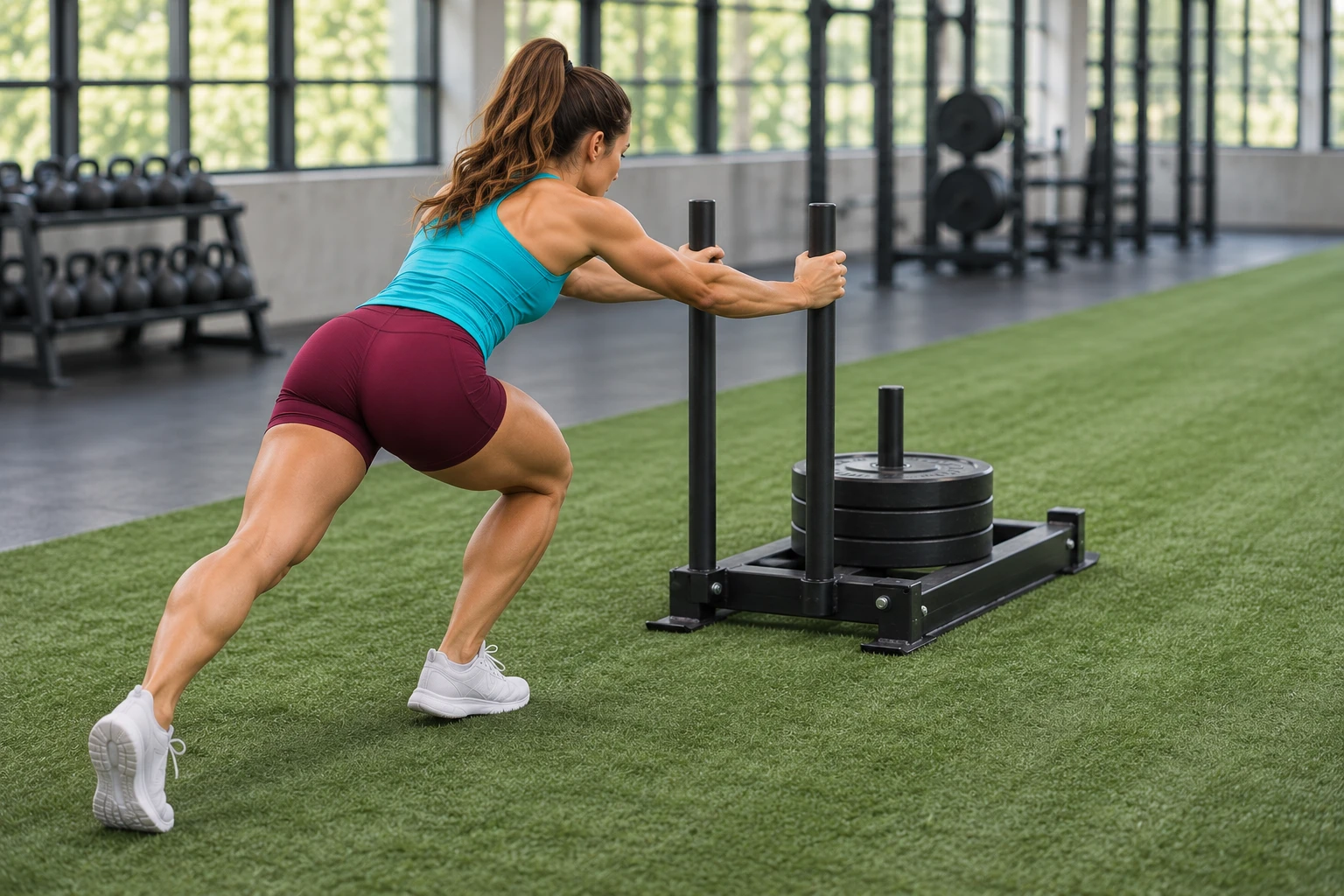
A sled push is a resisted movement in which you drive a weighted sled across the ground using repeated steps and pressure through its handles. It trains the ability to produce forward force against resistance. Athletes use it for lower-body strength, conditioning and preparation for events such as HYROX.
Definition
A sled push is a loaded locomotion exercise: the athlete walks or runs forwards while pushing a sled along the ground. Force travels from the feet through a supported trunk and arms into the sled.
Why it matters
It gives athletes a practical way to train force production while moving forwards. Depending on resistance, distance and recovery, the emphasis can shift towards heavy strength-oriented efforts or repeated conditioning work. Understanding that distinction helps prevent every session becoming an uncontrolled fatigue test.
Deeper explanation
To move the sled, you must overcome resistance at the sled–surface contact while maintaining enough grip underfoot to drive forwards. A heavier load usually slows movement on the same setup, but surface friction can change the demand substantially. The legs repeatedly generate propulsion while the upper body mainly holds position. Sled pushing typically involves less loaded lowering than exercises such as squats, but that does not make it fatigue-free or guarantee that it will not cause soreness.
Examples
A short, heavy push with generous recovery can emphasise force production. A lighter push performed at a controlled pace over repeated lengths can emphasise conditioning. In HYROX practice, a short run followed by a manageable sled push can introduce the challenge of arriving at the station with elevated breathing.
How to programme it
Choose the session goal before selecting resistance. One introductory example is four 10-metre pushes at a load that allows continuous, controlled steps, resting until you can repeat the same quality. This is a starting template, not a universal prescription. Record the sled, surface, added load, distance and recovery. Progress one variable at a time, and reduce the dose if technique or subsequent training quality deteriorates.
In HYROX and hybrid racing
The sled push is a HYROX workout station. Preparation should include efficient starts, sustained forward movement and controlled transitions back to running. Build reliable technique before adding run-to-sled combinations. Use the current rules for your division when checking competition requirements; a gym sled with the same loaded mass may still feel very different.
FAQs
+Which muscles does a sled push work?
The quadriceps, gluteal muscles and calves contribute to driving each step. The trunk and shoulder muscles help maintain position and transmit force through the handles. Their relative contribution changes with body angle, technique and resistance.
+Why does the same sled weight feel different on different surfaces?
Resistance depends on friction between the sled and the surface, not just the loaded mass. Sled design and surface condition also matter, while footwear affects your available traction. Compare sessions on the same setup where possible rather than treating plate weight as a universal measure.
+Can sled pushes replace running for HYROX?
No. Sled pushes develop station-specific ability and can challenge conditioning, but they do not reproduce the mechanics or repeated impact of running. HYROX preparation needs appropriate running practice as well as sled work.
Also known as: weighted sled push, prowler push
A sled push turns resistance into forward travel: you push through the handles while your legs keep the sled moving. The useful training question is not simply how much weight you can load, but whether the resistance matches the purpose of the session.
How do you perform it with control?
Take a secure grip and lean forwards as a whole body rather than folding through your lower back.
Brace your trunk and keep your shoulders supported. Choose an arm position you can maintain without collapsing.
Start with short, deliberate steps, pushing the ground behind you. Avoid reaching so far forwards that your feet slip.
Keep breathing throughout the effort. Finish under control before reaching the end of the available space.
How do you scale a sled push?
Reduce the added load first if you cannot initiate movement or maintain purposeful steps. Shorten the distance and allow more recovery if fatigue disrupts your position. Higher handles, where available, may allow a more upright posture, although they also change the mechanics.
If an empty sled is still too demanding, use a lighter sled or a more suitable surface. Do not rely on repeated jerking to move an unsuitable load. Check footwear and traction before assuming that more effort is the answer.
When should you stop the set?
End the effort if your feet repeatedly slip, your grip becomes insecure or you can no longer maintain a supported trunk and shoulder position. Stop exercising for sharp or increasing pain, dizziness, chest discomfort or unusual breathlessness. Seek qualified medical advice for concerning symptoms rather than attempting to push through them.