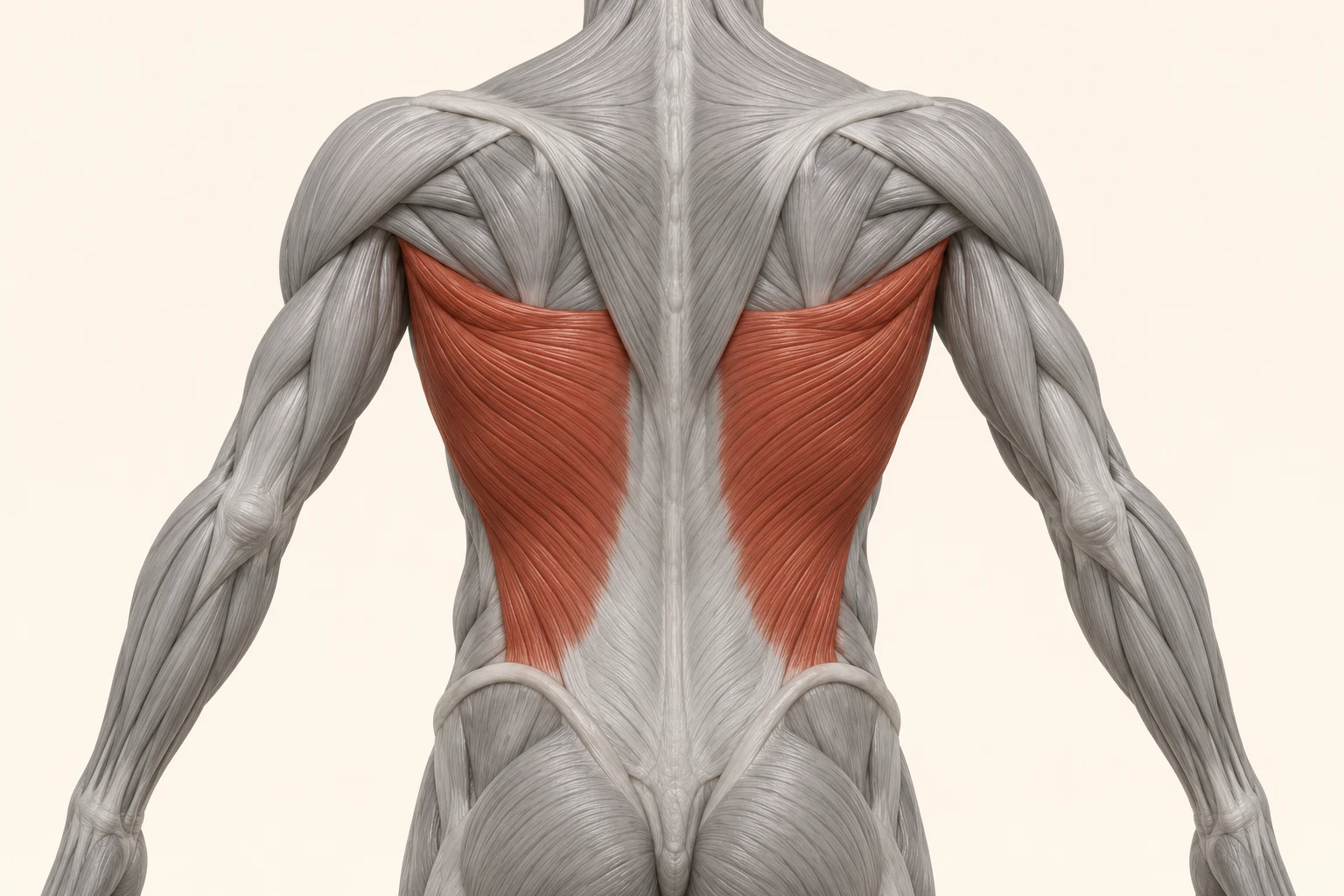
The latissimus dorsi is a large, broad muscle on each side of the back that moves the upper arm towards the body, backwards and into internal rotation. Often called the lats, these muscles contribute to pull-ups, rows and SkiErg strokes, making them relevant to strength training and hybrid racing.
Definition
The latissimus dorsi is a broad, superficial back muscle that connects the lower trunk to the upper arm. Its main shoulder actions are extension, adduction and internal rotation: moving the upper arm backwards, towards the body and rotating it inwards.
Why it matters
Understanding the lats helps athletes select pulling exercises and distinguish shoulder movement from simply bending the elbows. Strong, well-coordinated lats contribute to pulling strength, but they work alongside the elbow flexors, shoulder-blade muscles and trunk muscles rather than independently.
Deeper explanation
Each latissimus dorsi spans much of the lower and side of the back. It has attachments to the lower thoracic spine, the thoracolumbar fascia, the iliac crest of the pelvis and lower ribs, then narrows towards an attachment on the humerus near the shoulder. Because it crosses the shoulder joint, it can move the upper arm relative to the trunk. When the hands are fixed, as during a pull-up, it helps move the trunk towards the arms. Its contribution changes with arm position and the task being performed.
Examples
In a pull-up, the lats help bring the upper arms towards the sides as the body rises. In a row, they help draw the upper arms backwards. In a straight-arm cable pulldown, they contribute to moving the arms down from an overhead position while elbow movement stays limited. During a SkiErg stroke, they assist the downward and backward movement of the upper arms.
How to programme it
Build pulling work around a vertical pull, such as a pulldown or assisted pull-up, and a horizontal pull, such as a cable or chest-supported row. Choose resistance that allows controlled repetitions without jerking or forcing the shoulder into an uncomfortable position. Scale pull-ups with a suitable assistance machine or use pulldowns with a lighter load. For rows, reduce resistance or add chest support if trunk control limits the exercise. Increase load or repetitions gradually rather than changing everything at once.
In HYROX and hybrid racing
The lats contribute directly to SkiErg work and the pulling action of the sled pull. Neither station is a lat-only task: technique, grip, trunk control and lower-body contribution also matter. If SkiErg technique deteriorates, lower the stroke effort and shorten the work interval. Practise a coordinated stroke rather than trying to generate all the power with the arms.
FAQs
+Are the lats and latissimus dorsi the same thing?
Yes. Lats is the common shorthand for the latissimus dorsi muscles, one on each side of your back. They are distinct from the trapezius and other muscles that also contribute to pulling movements.
+Do rows and pull-ups train the lats in the same way?
Both train the lats, but the direction of the pull and the shoulder movement differ. Pull-ups bring the upper arms down from overhead, while rows generally draw them backwards. Grip, elbow path and technique affect how the work is shared with other muscles.
+Should you feel only your lats during SkiErg work?
No. SkiErg work coordinates the shoulders, arms, trunk and lower body. The lats help drive the upper arms down and backwards, but a strong stroke is not an isolated lat exercise. Not feeling a distinct lat sensation does not establish that the muscle is inactive.
Also known as: lats, latissimus dorsi muscle
What does the latissimus dorsi do during training?
The latissimus dorsi links the trunk to the upper arm and helps produce powerful pulling movements. A useful starting point is to watch what your upper arm does: moving it down towards your side or backwards involves the lats, although other muscles share the work.
How can you make pulling exercises more manageable?
Pull-up: use machine assistance or switch to a pulldown if you cannot complete controlled repetitions without swinging.
Row: lower the load and choose chest support if you repeatedly heave your torso to finish the pull.
Straight-arm pulldown: reduce the load or overhead reach if you need to arch your lower back to move the cable.
SkiErg: reduce effort and interval duration if fatigue turns the stroke into repeated uncontrolled arm pulls.
When should you stop a pulling exercise?
End the set when you can no longer maintain controlled movement. Stop the exercise if you develop sharp shoulder or back pain, numbness, tingling or dizziness rather than pushing through. Persistent or recurring symptoms warrant advice from a qualified healthcare professional; an anatomy glossary cannot identify their cause.
What is the practical takeaway?
Train the movement, not just the sensation of a single muscle. Use manageable pulling variations, allow natural shoulder-blade movement and progress when your repetitions remain controlled. For hybrid athletes, combine this strength work with station practice so that pulling capacity transfers to coordinated race movements.