
Glossary

farmer’s carry

farmer’s carry

Pronounced: FAHR-merz KA-ree

A farmer’s carry is a loaded walking exercise performed with a weight in each hand at your sides. It challenges grip, trunk control and the ability to move steadily under load. Athletes use it to develop practical carrying strength and prepare for tasks such as the HYROX farmers carry.

Definition

A farmer’s carry is a bilateral loaded carry: you walk while holding an external load in each hand, with your arms alongside your body. Dumbbells, kettlebells or purpose-built farmer’s handles can provide the resistance.

Why it matters

Carrying tests whether you can maintain grip and control your body while moving, rather than only producing force in a stationary lift. For hybrid athletes, it also exposes how grip fatigue, breathing and walking pace interact under load.

Deeper explanation

The hands maintain a largely isometric grip while the legs produce repeated walking steps. The trunk and shoulder muscles help manage the movement of the body and weights. Load, distance, speed, handle thickness and turns all influence difficulty, so equal distances with different equipment are not necessarily equivalent efforts.

Examples

Walking with two kettlebells along a clear gym lane is a farmer’s carry. Carrying two dumbbells over a shorter distance is another version. A single kettlebell held at one side is a suitcase carry, while weights supported at the shoulders make the exercise a front-rack carry.

How to programme it

For a simple starting session, try three carries of 20 metres with a manageable load, resting until you can repeat the same controlled technique. This is an example, not a universal target. Increase load or distance gradually rather than changing both together. Put carries earlier in a session when grip quality is the priority, or after main lifts when they are accessory work.

In HYROX and hybrid racing

The HYROX farmers carry uses kettlebells and follows earlier running and station work. Preparation should include controlled pick-ups, turns and set-downs, not just straight-line walking. Build sound technique while fresh before practising carries after running. Check the current event rules for your division’s required load and movement standards.

FAQs

+What muscles does a farmer’s carry work?
The finger and forearm muscles maintain your grip, while muscles around the shoulders and trunk stabilise the load and torso. The glutes, quadriceps and calves contribute to supporting and moving your body as you walk.
+How heavy should a farmer’s carry be?
Choose a load that allows a controlled pick-up, steady steps and a deliberate set-down throughout the planned distance. Reduce the load or distance if you repeatedly lose your grip, lean markedly or cannot control the weights.
+Is a farmer’s carry the same as a suitcase carry?
No. A farmer’s carry normally uses a weight in each hand. A suitcase carry uses a weight on one side, creating an uneven load that challenges your ability to resist sideways bending.

Also known as: Farmer carry, Farmers carry, Farmer’s walk

How do you perform a farmer’s carry?

The movement is straightforward: pick up two weights, walk with them at your sides and put them down under control. The useful training challenge is keeping that sequence consistent as fatigue builds.

  • Clear your route and leave enough room to turn without clipping equipment or other people.
  • Stand between the weights. Bend at your hips and knees, take a secure grip and stand up with the loads close to your sides.
  • Keep your arms long, your head comfortably upright and your torso controlled. Avoid deliberately shrugging or leaning backwards.
  • Walk with steady, deliberate steps while continuing to breathe. Let your pace follow your control of the weights.
  • Slow down before turning. At the finish, stop walking, bend at the hips and knees and lower the weights deliberately.

How can you scale the movement?

Use lighter weights or shorten each carry before technique deteriorates. If picking weights up from the floor is the limiting task, suitable stable raised supports can reduce the pick-up range. Keep the walking lane flat and clear while learning.

Handles should allow a secure grip. Switching equipment can change the challenge substantially, so record the implement as well as the load and distance. Lifting straps reduce the grip demand and are not an equivalent substitute when grip endurance is the goal.
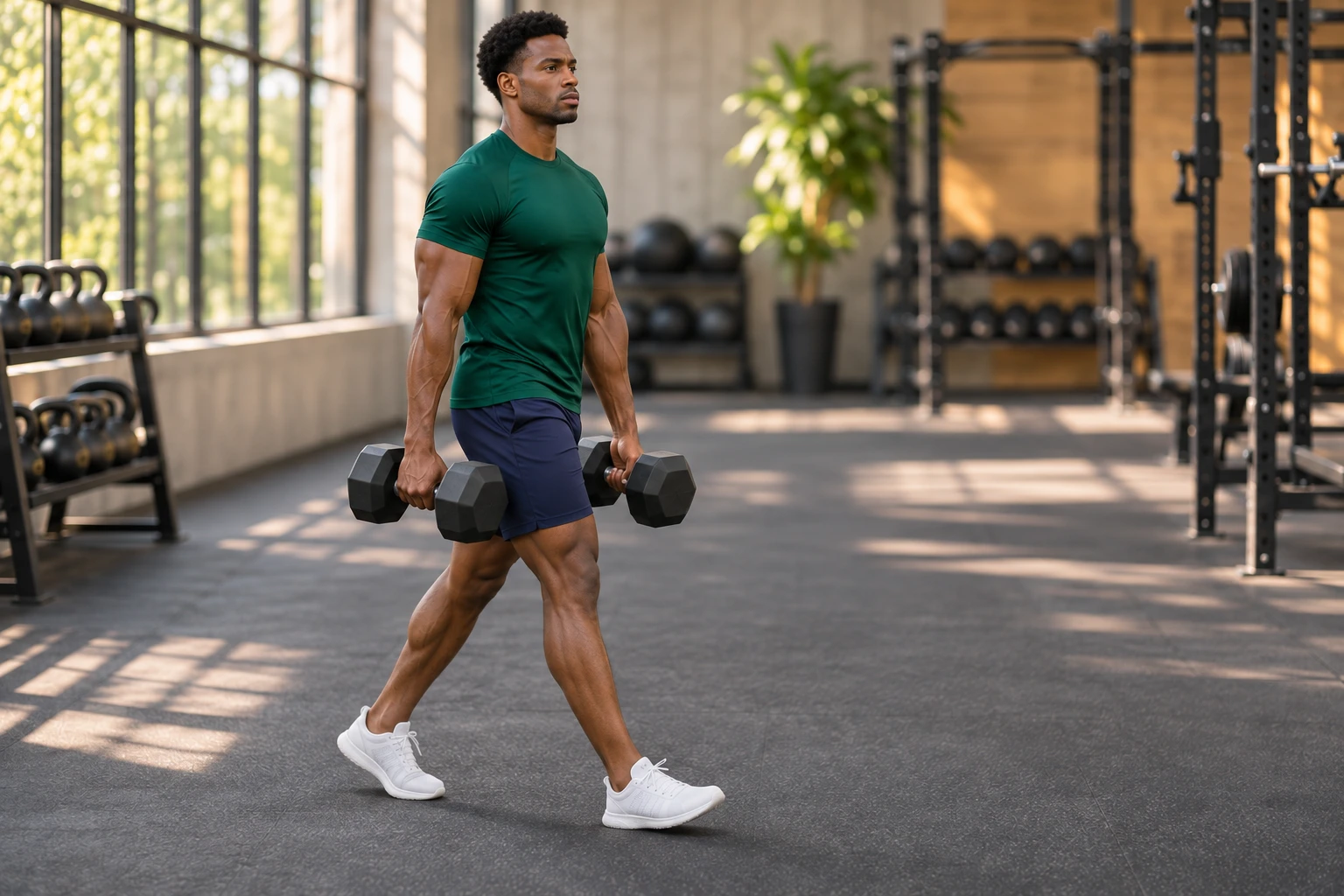
Side view of an athlete walking upright through a gym with a dumbbell in each hand.

When should you stop a carry?

End the repetition before your grip opens involuntarily or the weights become uncontrolled. Set them down safely if you stumble repeatedly, develop a pronounced lean or cannot maintain a clear route. Grip fatigue is a reason to rest, not to rush the remaining distance.

Stop training if you experience sharp pain, numbness, dizziness or unusual breathlessness. Persistent or recurring symptoms need qualified medical advice rather than a technique adjustment alone.