
Lateral band walk
A sideways stepping exercise against a loop band that trains the outer hips while challenging pelvic and knee control.

Setup
- Place a light loop resistance band around your thighs, just above the knees.
- Stand with feet approximately hip-width apart and enough band tension to remove slack.
- Soften your knees and hinge slightly at the hips; use a shallow athletic position rather than a deep squat.
- Keep your feet pointing forwards, brace gently and check that you have a clear path in both directions.
Execution
- Shift your weight onto the supporting leg without leaning your torso sideways.
- Step the other foot sideways a short distance, keeping the knee aligned with the toes.
- Place that foot down quietly and transfer your weight with control.
- Bring the trailing foot towards it until you return to your starting width, retaining band tension.
- Continue for the planned steps, then reverse direction using the same posture and step length.
Coaching cues
- Small steps, steady hips.
- Keep your belt line level.
- Let your knees follow your toes without forcing them outwards.
- Move the feet without swaying the shoulders.
Common faults & fixes
- Torso rocking from side to side: shorten each step and reduce the band resistance.
- Knees collapsing inwards: use a lighter band and maintain knee alignment over the feet.
- Feet snapping together: slow the trailing step and finish each repetition at your starting width.
- Dropping into an increasingly deep squat: reset to a shallow knee bend and keep your height consistent.
Regressions
- Use a lighter band above the knees to reduce the resistance.
- Practise unbanded side steps while keeping your pelvis level and your feet pointing forwards.
- Reduce each set to three to five steps per direction, resetting your posture between sets.
Variations
- Ankle-band lateral walk: move a light band to the ankles and keep each foot clear of the floor as you step.
- Paused lateral band walk: briefly stabilise after each lead-foot step before bringing the trailing foot across.
- Controlled-tempo lateral band walk: slow both the outward step and the trailing-foot return without letting the band pull you off balance.
Programming ideas
- Before a lower-body session: perform one or two sets of six to eight steps each way with light resistance, stopping well before fatigue changes your technique.
- As an accessory: perform two or three sets of eight to twelve steps each way, resting enough to maintain control.
- On an easy training day: pair short sets with calf raises or simple balance work; increase resistance only when every step remains steady.
Safety
Inspect the band for tears and use a clear, non-slip surface. Keep the band off the knee joints. End the set when you cannot maintain knee alignment, pelvic control or deliberate foot placement. Stop the exercise for sharp pain, joint pinching, numbness or tingling. If you have an existing hip, knee or ankle condition, seek clinician guidance before using this exercise for rehabilitation.
In depth
Why use the lateral band walk?
Running and many HYROX movements predominantly move you forwards or vertically. Lateral band walks add a simple sideways resistance exercise, asking the hip muscles to move the legs apart while controlling the pelvis. They complement heavier strength work without needing much space or equipment.
When should you programme it?
Use a light band before squats, lunges or running if the drill helps you rehearse controlled movement. Keep warm-up sets brief rather than chasing fatigue. For additional hip-abductor work, place more challenging sets after your main lifts. Progress resistance gradually: a stronger band is only useful if your steps remain controlled.
+Where should the band sit?
+Should you feel lateral band walks in your glutes?
+Can lateral band walks replace lower-body strength training?
Keep training
Related exercises

Barbell Split Squat
Shared: Glutes, Hip Stabilizers, Stability

Single-Leg Alternating Lateral Box Bounds
Shared: Abductors, Glutes, Lateral
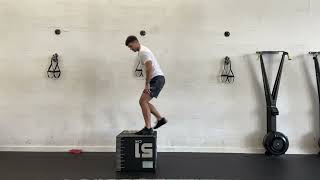
Single-Leg Box Hop to Lateral Bound
Shared: Abductors, Glutes, Lateral

Single-Leg Box Hop to Lateral Bound & Return
Shared: Abductors, Glutes, Lateral

Single-Leg Continuous Lateral Bounds
Shared: Abductors, Glutes, Lateral

Single-Leg Continuous Lateral Bounds to Box
Shared: Abductors, Glutes, Lateral