
Dumbbell Biceps Curl
A strict dumbbell isolation exercise that builds elbow-flexor strength as an accessory to compound pulling and hybrid training.

Setup
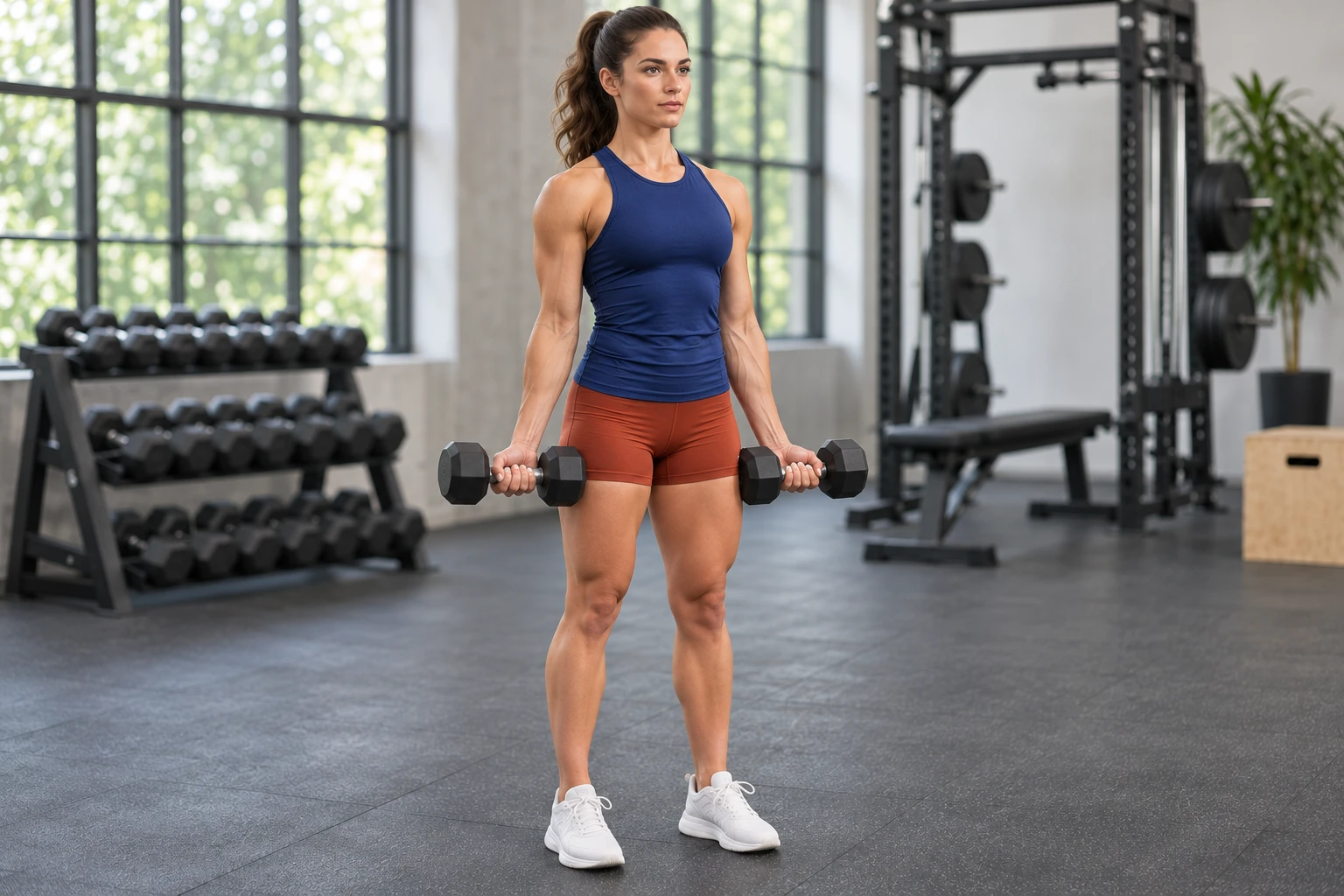
- Choose two dumbbells you can lift without using momentum and clear space around your sides.
- Stand with feet comfortably apart, knees relaxed and weight distributed evenly through both feet.
- Hold the dumbbells beside your thighs with palms facing forwards and wrists straight.
- Keep your ribs over your pelvis, shoulders relaxed and upper arms close to your sides.
Execution
- Brace gently and bend both elbows to raise the dumbbells without moving your torso.
- Keep your wrists in line with your forearms and your upper arms mostly still.
- Lift as far as you can comfortably while maintaining that position; the weights do not need to touch your shoulders.
- Lower smoothly until your elbows are comfortably straight, without forcing them into extension.
- Reset your position and repeat, breathing steadily throughout.
Coaching cues
- Keep your ribs stacked over your hips.
- Bend the elbows; do not throw the weights.
- Keep wrists straight rather than curling your hands.
- Own the lowering phase.
Common faults & fixes
- Swinging the torso: reduce the weight and pause briefly at the bottom before each repetition.
- Leaning backwards as fatigue builds: end the set when you can no longer keep your trunk upright.
- Lifting the elbows forwards to finish: stop the upward phase earlier and keep the upper arms beside your torso.
- Dropping the dumbbells on the descent: use a lighter load and take around two seconds to lower each repetition.
Regressions
- Use lighter dumbbells while retaining a comfortable, controlled range of motion.
- Curl one arm at a time, keeping the other weight still at your side, to simplify coordination.
- Practise with your upper back lightly against a wall to make torso swinging easier to detect; do not push into the wall for leverage.
Variations
- Alternating dumbbell curl: complete one controlled repetition per side while keeping your trunk still.
- Incline dumbbell curl: use an incline bench with arms hanging slightly behind the torso, starting lighter and avoiding uncomfortable shoulder extension.
- Hammer curl: keep palms facing each other throughout for a neutral-grip elbow-flexion option.
Programming ideas
- Strength accessory: perform 2–3 sets of 8–12 repetitions after your main pulling exercises, resting 60–90 seconds between sets.
- Lighter accessory session: perform 2 sets of 12–15 controlled repetitions, stopping before you need momentum.
- Progression: when every set reaches the top of your chosen repetition range with about two repetitions in reserve, increase the load by the smallest available increment.
Safety
Stop the set if you develop sharp or increasing elbow, wrist or shoulder pain, numbness, or loss of control. Do not force the bottom position or continue by swinging. Reduce the load when technique deteriorates. Persistent symptoms, an existing medical condition or return after injury require individual review by an appropriate clinician; these instructions are educational, not rehabilitation advice.
In depth
Why use the dumbbell biceps curl?
The curl trains elbow flexion directly, giving the muscles that bend your elbows focused work without requiring another demanding full-body lift. For hybrid athletes, it is a useful supplement to rows and sled pulls, particularly when you want extra arm-strength work with modest equipment needs. It is an accessory, not a substitute for practising those movements.
When should you programme it?
Place curls towards the end of a strength session, after priority pulling work. Avoid fatiguing your elbow flexors immediately before hard sled-pull practice or heavy rows. Start with a small amount of weekly work and assess how your arms recover before adding sets. Consistent, controlled repetitions matter more than lifting the heaviest available dumbbells.
+Are dumbbell biceps curls useful for HYROX training?
+Should your elbows move forwards during a curl?
+How heavy should your dumbbells be?
Keep training
Related exercises

Pull-Up Hold
Shared: Biceps, Forearms, Pull

Dumbbell Meadows Row
Shared: Biceps, Dumbbells, Pull

Renegade Row
Shared: Biceps, Dumbbells, Pull

Single-Arm Dumbbell Dead Stop Row
Shared: Biceps, Dumbbells, Pull

Barbell Bent-Over Row
Shared: Forearms, Pull

Barbell Clean
Shared: Forearms, Pull