
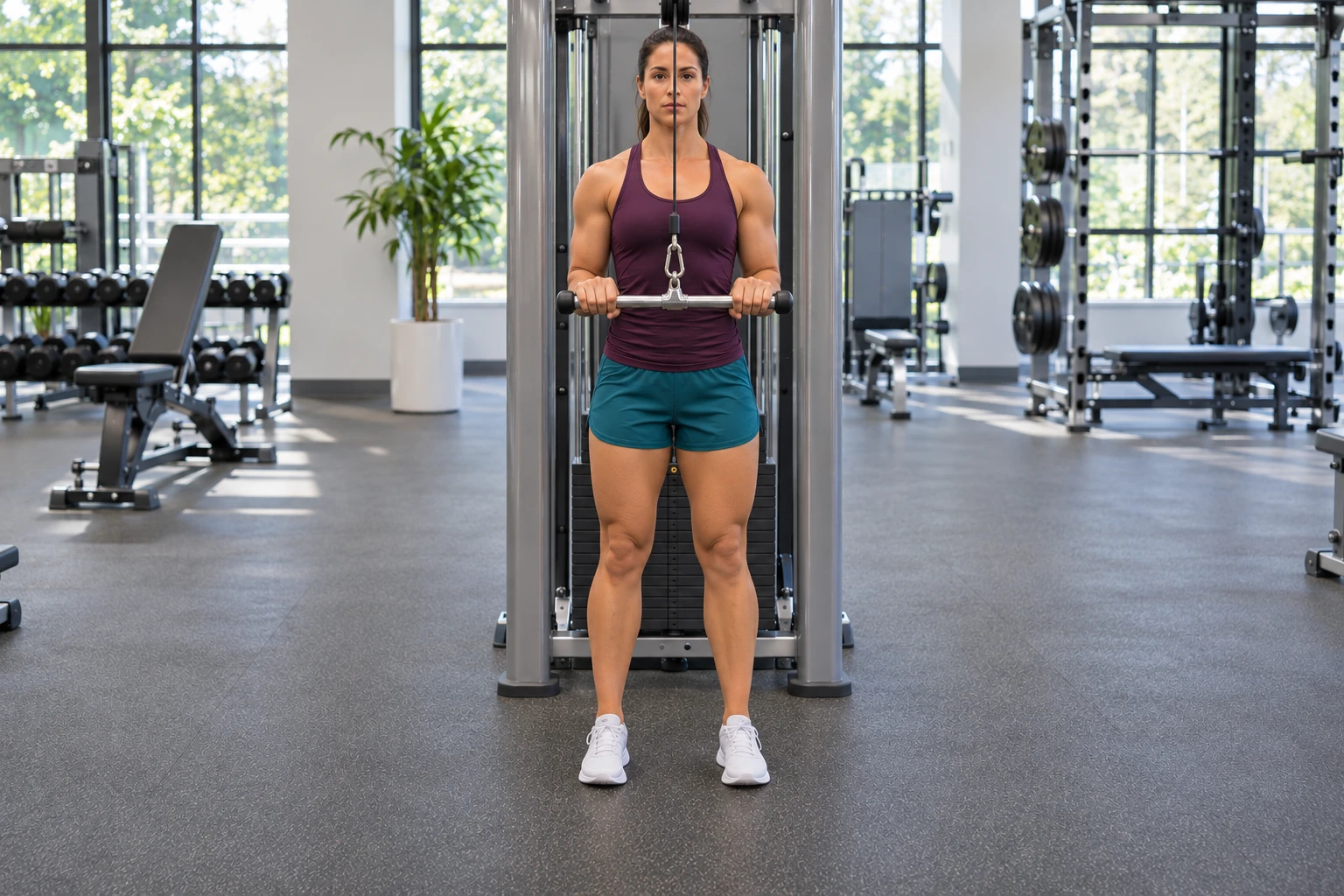
Cable triceps pushdown
A cable isolation exercise for the triceps, useful as controlled accessory work after compound pressing.

Setup
- Set a cable pulley to its highest position and securely attach a straight bar or rope.
- Select a light starting load and check that the weight-stack pin is fully inserted.
- Face the machine with your feet comfortably spaced and knees slightly soft.
- Take the handle, bring your upper arms beside your ribs and brace gently with your wrists in line with your forearms.
Execution
- Start with bent elbows and the cable under tension, standing far enough back for the handle to clear your body.
- Straighten your elbows to press the handle down while keeping your upper arms largely still.
- Finish with your arms straight without forcefully snapping or pushing beyond a comfortable elbow position.
- Let the handle rise slowly by bending your elbows, keeping your shoulders quiet.
- Repeat through a comfortable range without leaning farther forwards or allowing the weight stack to crash.
Coaching cues
- Keep your upper arms beside your ribs, not jammed tightly against them.
- Move at the elbows; keep your shoulders quiet.
- Keep your wrists straight rather than curling the handle down.
- Stand tall through your trunk—do not turn the repetition into a bodyweight press.
Common faults & fixes
- Rocking forwards to move the load: reduce the weight and hold the same torso angle throughout.
- Driving the elbows backwards: keep the upper arms steady and finish the repetition by straightening the elbows.
- Bending the wrists: ease your grip slightly and keep your knuckles aligned with your forearms.
- Letting the handle spring upwards: slow the return and lower the load if you cannot control it.
- Forcing the bottom position: straighten the arms smoothly without snapping the elbows or chasing extra range.
Regressions
- Reduce the cable load until you can complete every repetition without torso movement.
- Use a shorter, pain-free range while practising control, gradually restoring comfortable elbow movement rather than forcing it.
- Practise a resistance-band pushdown with a light band secured to a suitable overhead anchor; inspect the band and anchor before starting.
Variations
- Rope pushdown: allow the hands to separate naturally near the bottom without pulling the elbows backwards.
- Single-arm cable pushdown: train each arm separately with a suitable single handle and keep your torso square.
- Tempo pushdown: take three seconds to return the handle while maintaining the same controlled pressing action.
Programming ideas
- After compound pressing, try 2–3 sets of 10–15 repetitions, finishing with roughly two controlled repetitions still available.
- For a short accessory session, alternate pushdowns with a rowing exercise, resting enough to preserve technique in both movements.
- Increase the load by the smallest available increment once all planned repetitions are controlled; avoid adding weight at the expense of elbow position.
- Keep demanding pushdown sets away from priority wall-ball practice if local arm fatigue reduces your throwing technique.
Safety
Check the attachment clip, cable and weight-stack pin before use. Stop the set if you develop sharp pain, elbow or shoulder discomfort, tingling, or cannot control the return. Stop immediately if the cable catches or the attachment shifts. Do not force elbow hyperextension. Existing elbow or shoulder conditions need clinician review before using this exercise as rehabilitation.
In depth
Why use the cable triceps pushdown?
The pushdown trains elbow extension without requiring another full pressing exercise. It is a straightforward way to add targeted triceps work after your main lifts. For hybrid athletes, its role is supplementary: it trains muscles involved in pressing, but does not reproduce the leg drive, coordination or pacing demands of wall balls.
When should you include it?
Place pushdowns towards the end of an upper-body or full-body strength session, once priority compound lifts and technical work are complete. Start light enough to keep the shoulders still and the return controlled. If training time or recovery is limited, prioritise your main strength exercises and event-specific work before adding isolation sets.
+Where should you feel a cable triceps pushdown?
+Is a rope or straight bar better?
+Does this replace pressing or wall-ball practice?
Keep training
Related exercises

Barbell Overhead Press
Shared: Triceps, Push

Barbell Power Jerk
Shared: Triceps, Push

Barbell Push Press
Shared: Triceps, Push

Barbell Split Jerk
Shared: Triceps, Push

Barbell Thruster
Shared: Triceps, Push

Bench Press
Shared: Triceps, Push