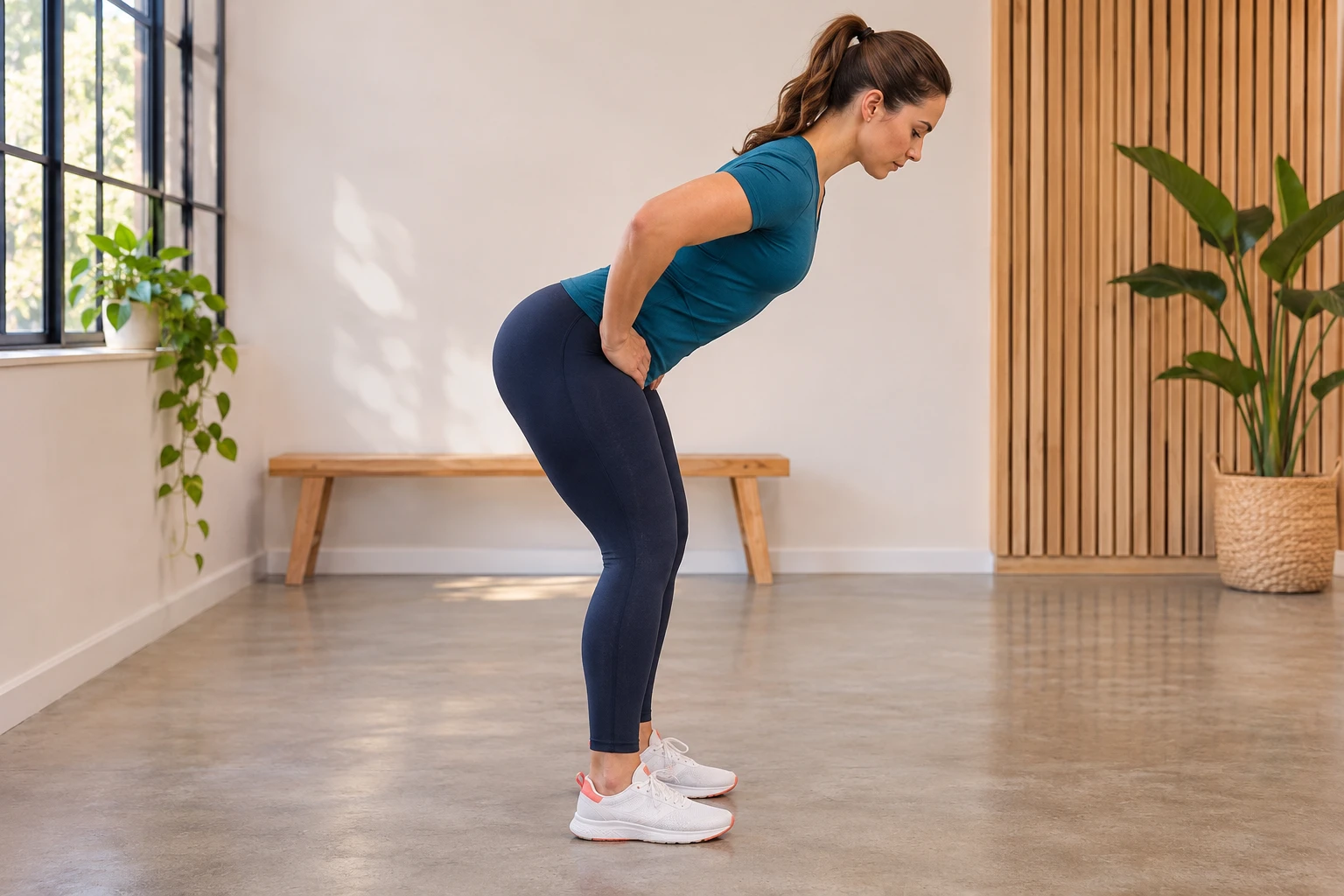
A hip hinge is a movement pattern in which you bend mainly at the hips, sending them backwards while keeping your trunk controlled and allowing some knee bend. It underpins deadlifts, Romanian deadlifts and kettlebell swings, helping athletes load the hip extensors and distinguish hip-dominant lifting from squatting.
Definition
A hip hinge is a hip-dominant movement pattern: the hips flex as the pelvis moves backwards and the torso inclines, then extend to return to standing. The knees can bend, while the trunk remains controlled rather than deliberately rounding to create extra reach.
Why it matters
Understanding the hinge helps athletes distinguish hip movement from simply bending through the back. It provides a practical foundation for loading the glutes and hamstrings, selecting an appropriate lifting range and learning hip-dominant strength exercises.
Deeper explanation
During the lowering phase of a Romanian deadlift, the hip extensors work eccentrically to control hip flexion. During the ascent, they work concentrically to extend the hips. The trunk muscles help resist unwanted spinal movement. A hinge is a pattern, not a single exercise: load position, knee bend, speed and range differ between deadlifts, good mornings and kettlebell swings.
How to programme it
Practise an unloaded hinge during a strength warm-up before adding resistance. For an introductory drill, try two sets of five slow wall-touch repetitions, prioritising repeatable control rather than fatigue. Progress to a light Romanian deadlift when you can move the hips back and return smoothly. Treat ballistic exercises such as kettlebell swings as a separate skill progression, not simply a heavier or faster beginner drill.
In HYROX and hybrid racing
Hip-hinge control is useful when picking up kettlebells for the farmer's carry and during strength preparation with deadlift variations. Pick-ups may require more knee bend than a Romanian deadlift. The hinge is not a universal station technique: wall balls and lunges involve different movement demands.
FAQs
+What is the difference between a hip hinge and a squat?
A hip hinge emphasises moving the hips backwards, usually with less knee bend and a more inclined torso. A squat involves more knee flexion as the hips lower. Both use the hips and knees; the distinction is their relative contribution, not an absolute separation.
+Should your knees stay straight during a hip hinge?
No. Allow some knee bend rather than locking the knees. The amount depends on the exercise: a Romanian deadlift generally uses less knee bend than a conventional deadlift from the floor.
+Do you need to touch the floor?
No. Hinge depth depends on the exercise, your proportions and the range you can control. In a Romanian deadlift, lower only as far as you can maintain the intended trunk position and keep the load close. Reaching the floor is not the goal.
Also known as: hip-hinge pattern
How do you practise a hip hinge?
The defining action is folding at the hips while keeping the trunk controlled. Start without weight so you can learn the movement without chasing load or depth.
Stand facing away from a wall, with your heels a short distance from it and feet roughly hip-width apart.
Soften your knees and gently brace your trunk.
Push your hips backwards until your buttocks lightly touch the wall. Keep your whole foot in contact with the floor.
Return to standing by extending your hips. Finish tall rather than leaning backwards.
Adjust your distance from the wall so the movement stays controlled and you do not fall back onto it.
How should you scale loaded hinge exercises?
For a Romanian deadlift, reduce the weight and shorten the lowering range if you cannot keep the load close or maintain your intended trunk position. For a deadlift from the floor, raise the weight onto stable blocks to reduce the reach required.
If a kettlebell swing becomes a rushed squat or an uncontrolled back movement, return to a controlled kettlebell deadlift. Establish the start position, hip drive and balanced finish before reintroducing speed.
When should you stop a set?
End the set if you repeatedly lose balance, cannot control the load or cannot maintain the intended movement after a reset. Reduce the load or range before trying again.
Stop exercising if you experience sharp or worsening pain, numbness or dizziness. Do not use technique cues to push through these symptoms; seek qualified medical advice if they persist or recur.