
Pogo jumps
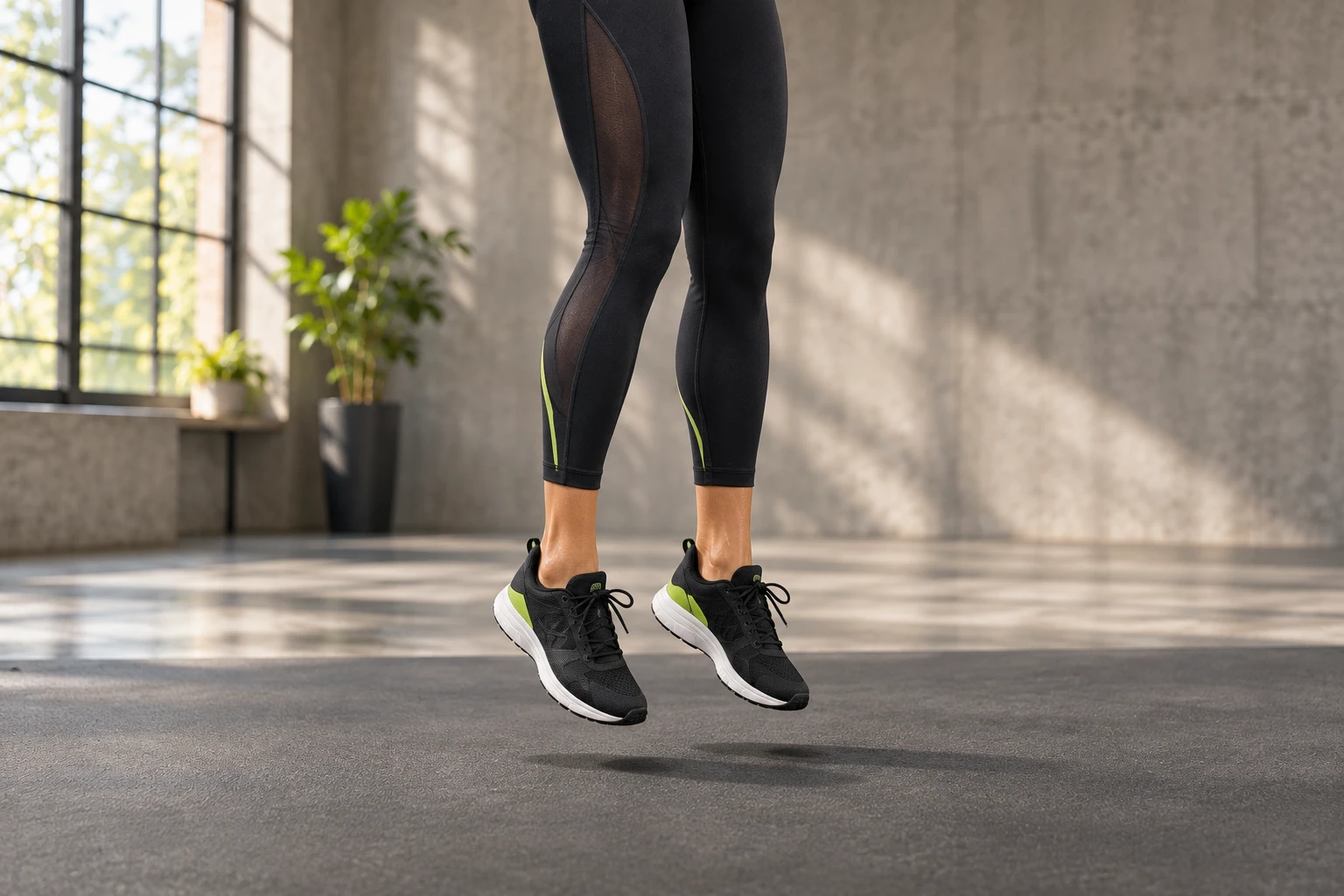
Low, rhythmic ankle-driven jumps that train controlled rebound and repeatable landing mechanics for running and hybrid training.

Setup
- Choose a level, non-slip surface with clear space overhead and around you.
- Stand with feet roughly hip-width apart and weight distributed evenly.
- Keep your knees soft, torso upright and head facing forwards.
- Warm up with easy walking or jogging, ankle movements and controlled calf raises.
Execution
- Push through the balls of both feet to lift just a few centimetres off the floor.
- Keep your hips tall and use only a small amount of knee bend.
- Land beneath your body, allowing the ankles to yield slightly without collapsing into a squat.
- Rebound into the next low jump with a steady rhythm and minimal forward travel.
- Finish by absorbing the final landing with slightly more knee bend, then stand still.
Coaching cues
- Think small bounces, not maximum-height jumps.
- Stay tall through the hips with soft knees.
- Make each landing quiet and each rebound similar.
- Bounce beneath your body rather than reaching forwards with your feet.
Common faults & fixes
- Deep knee bend on every repetition: lower the jump height and focus on ankle-driven movement.
- Locked knees and jarring landings: soften the knees and allow a small amount of ankle movement on contact.
- Drifting forwards or sideways: use a floor marking as a reference and shorten the set.
- Heavy landings or a slowing rhythm: stop the set, recover fully and reduce repetitions.
Regressions
- Practise controlled two-leg calf raises first to become familiar with pushing through the forefoot; these remove the landing demand.
- Perform one low jump at a time, settling fully between repetitions before linking rebounds.
- Use light fingertip support against a stable wall for very low pogo jumps if balance limits control.
Variations
- Forward-travelling pogos: cover a small distance on each bounce while keeping contacts underneath you.
- Lateral line pogos: bounce a short distance side to side over a floor line, keeping both feet together in rhythm.
- Single-leg pogos: progress to short sets on one leg only after two-leg repetitions are consistently controlled and comfortable.
Programming ideas
- Introduction: try 2 sets of 8–10 low jumps, resting 45–60 seconds between sets.
- Warm-up drill: perform 2–3 sets of 10–15 contacts after general warm-up activity and before running drills.
- Progression: add a few contacts to one set or introduce a small travelling component, rather than increasing volume and difficulty together.
Safety
Use supportive footwear and a predictable surface; avoid slippery flooring or unstable mats. Stop if you develop sharp pain, increasing Achilles or foot discomfort, dizziness, or an inability to maintain controlled landings. End the set when rhythm or landing quality deteriorates. If you have an existing lower-limb injury, recent surgery or a medical condition affecting impact exercise, have a clinician review suitability before starting.
In depth
Why use pogo jumps in hybrid training?
Running involves repeated landings and push-offs. Pogo jumps provide a simple drill for practising ankle-driven rebound and maintaining posture across repeated contacts. Unlike box jumps, the emphasis is on low height and consistent rhythm rather than clearing an obstacle. They complement strength work without replacing calf strengthening or running practice.
When should you introduce them?
Introduce them when basic calf raises and small two-foot landings feel controlled and comfortable. Place them early in a session, after warming up, rather than after exhausting sled work or intervals. For HYROX preparation, treat them as a running-support drill, not a race station or a test of how long you can keep bouncing.
+How are pogo jumps different from squat jumps?
+Should your heels touch the floor during pogo jumps?
+When should hybrid athletes programme pogo jumps?
Keep training
Related exercises

Single-Leg Lateral Bound to Vertical Jump & Return
Shared: Calves, Open Space, Plyometric, Vertical

Med Ball Scoop Toss (Vertical Power)
Shared: Calves, Plyometric, Vertical

Single-Leg Lateral Box Bound to Vertical Jump
Shared: Calves, Plyometric, Vertical

Burpee to Target Jump (Hybrid Plyometric)
Shared: Calves, Bodyweight, Wall, Plyometric

Single-Leg Continuous Lateral Bounds
Shared: Calves, Open Space, Plyometric

Single-Leg Lateral Skater Hop to Stick
Shared: Calves, Bodyweight, Plyometric